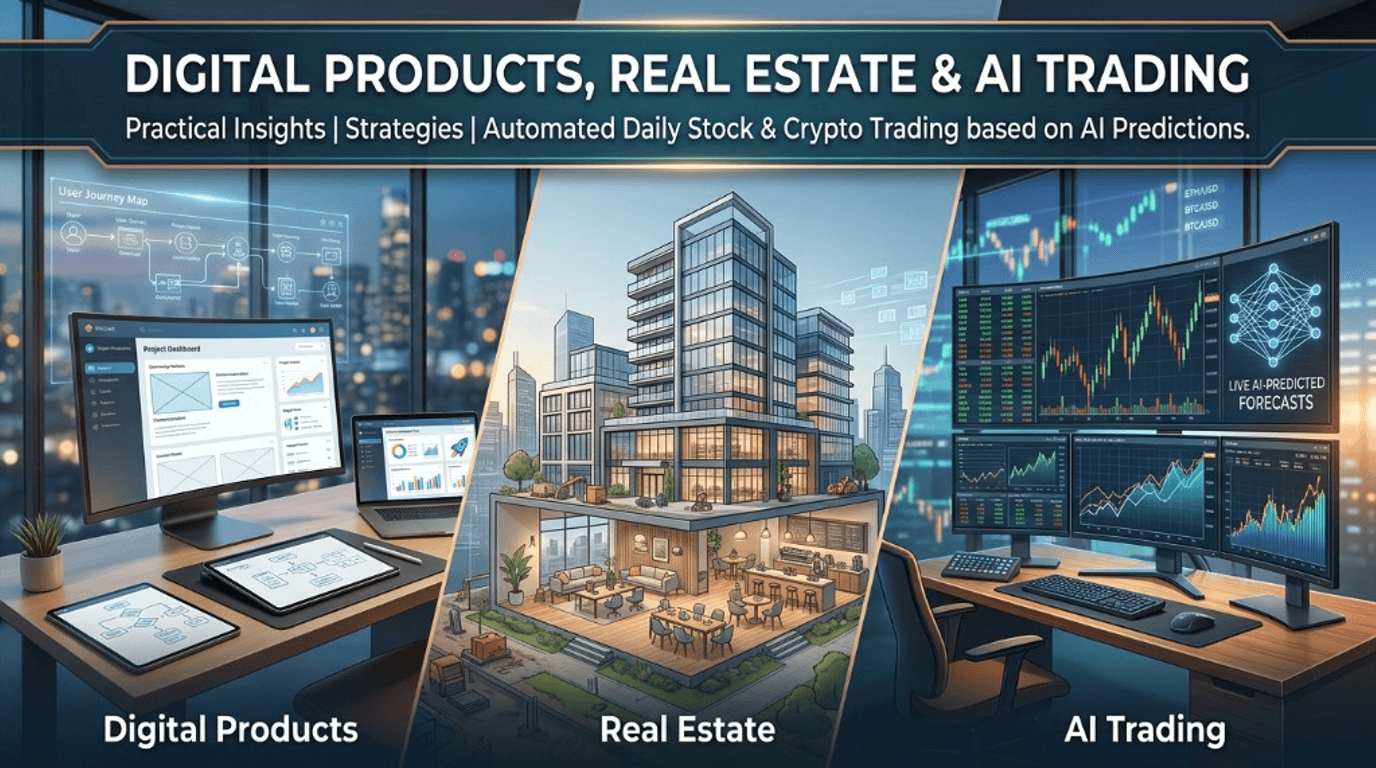
This is a place where all our writing settles. We explore the development of digital products and their strategies, real estate development and decor, and automated daily stock and crypto trading based on AI predictions. Our goal is to share clear, accessible insights and practical strategies without technical jargon. We use Gemini Deep Research API to generate blog posts on various topics and Nano Banana 2 API to generate hero images.
Generative AI and the Future of Accessible Residential Design
2026-11-10

Generative artificial intelligence is revolutionizing accessible residential design by enabling homeowners and caregivers to instantly visualize living spaces tailored for aging in place. By pairing advanced AI thinking models with browser-based 3D rendering technologies like WebGL, these platforms eliminate the steep learning curves and high costs associated with traditional architectural drafting. Users can rapidly prototype and iterate on universal design features, including crucial modifications for mobility and Mild Cognitive Impairment, in an immersive 3D environment. This democratization of spatial planning empowers individuals to create supportive, cognitively inclusive homes while bridging the gap between early conceptualization and final, code-compliant blueprints. Further
The Inclusive Future of Generative Architecture
2026-11-09

As the global population ages, the vast majority of existing residential housing is fundamentally unequipped to support changing mobility and cognitive needs. Instead of relying on expensive, reactive retrofits, homeowners and designers are now leveraging generative artificial intelligence to proactively plan accessible, barrier-free living spaces. By translating natural language prompts into strict mathematical blueprints, AI tools instantly enforce critical universal design principles like zero-step entries and 60-inch turning radii. This technological shift not only drastically reduces preliminary design costs but also democratizes the creation of safe, inclusive homes tailored for aging in place. Further
Architecting Proactive Digital Ecosystems: A Comprehensive Guide to Modern Product Engineering
2026-11-08

The landscape of digital product engineering is shifting from static, reactive tools to dynamic, proactive ecosystems. To achieve this, modern applications leverage a decoupled architecture that seamlessly orchestrates web frameworks like Nuxt, native mobile environments, real-time databases via GCP, and predictive personalization through Vertex AI. Furthermore, integrating edge computer vision with MediaPipe and secure financial routing via Stripe Connect allows developers to create deeply intuitive and resilient platforms. Ultimately, engineering these technologies in perfect harmony yields scalable applications that anticipate user needs and deliver zero-friction experiences. Further
From Rigid Rules to Dynamic AI: The Evolution of Automated Trading Risk Management
2026-11-07

This comprehensive report explores the critical transition from rigid, rules-based trading systems, such as traditional fixed stop-losses, to dynamic AI-driven architectures. By leveraging probabilistic forecasting and time-series foundation models, modern automated trading platforms can seamlessly adapt to natural market volatility. Furthermore, synthesizing these statistical guardrails with real-time news sentiment analysis allows systems to instantly protect capital during unexpected macroeconomic shocks. Ultimately, this paradigm shift democratizes institutional-grade risk management for retail investors, replacing emotional decisions with resilient, adaptable safety nets. Further
The Revolution of Generative AI in Residential Architecture
2026-11-06

Generative artificial intelligence is fundamentally transforming residential design by shifting the process from complex 2D drafting to instant, conversational 3D spatial planning. Through advanced reasoning models and interactive web-based platforms, homeowners can now use natural language to instantly generate and explore structurally logical, fully navigable 3D models of their future homes. This democratization of spatial intelligence empowers individuals to rapidly iterate on designs, saving thousands in early conceptual fees while utilizing autonomous AI agents to ensure layouts adhere to architectural best practices. Ultimately, this technology bridges the historical visualization gap, allowing users to seamlessly transition from abstract lifestyle requirements to practical blueprints ready for professional review. Further