 BAKO
The New Era of Algorithmic Alpha: AI Time-Series Forecasting in Daily Trading
2026-11-26

Disclaimer: The information provided in this article is for educational and informational purposes only and does not constitute professional financial or investment advice. Automated trading and financial market investments carry significant risk, and past performance of predictive models is not indicative of future results. Always consult with a licensed financial professional before making investment decisions.
Executive Summary
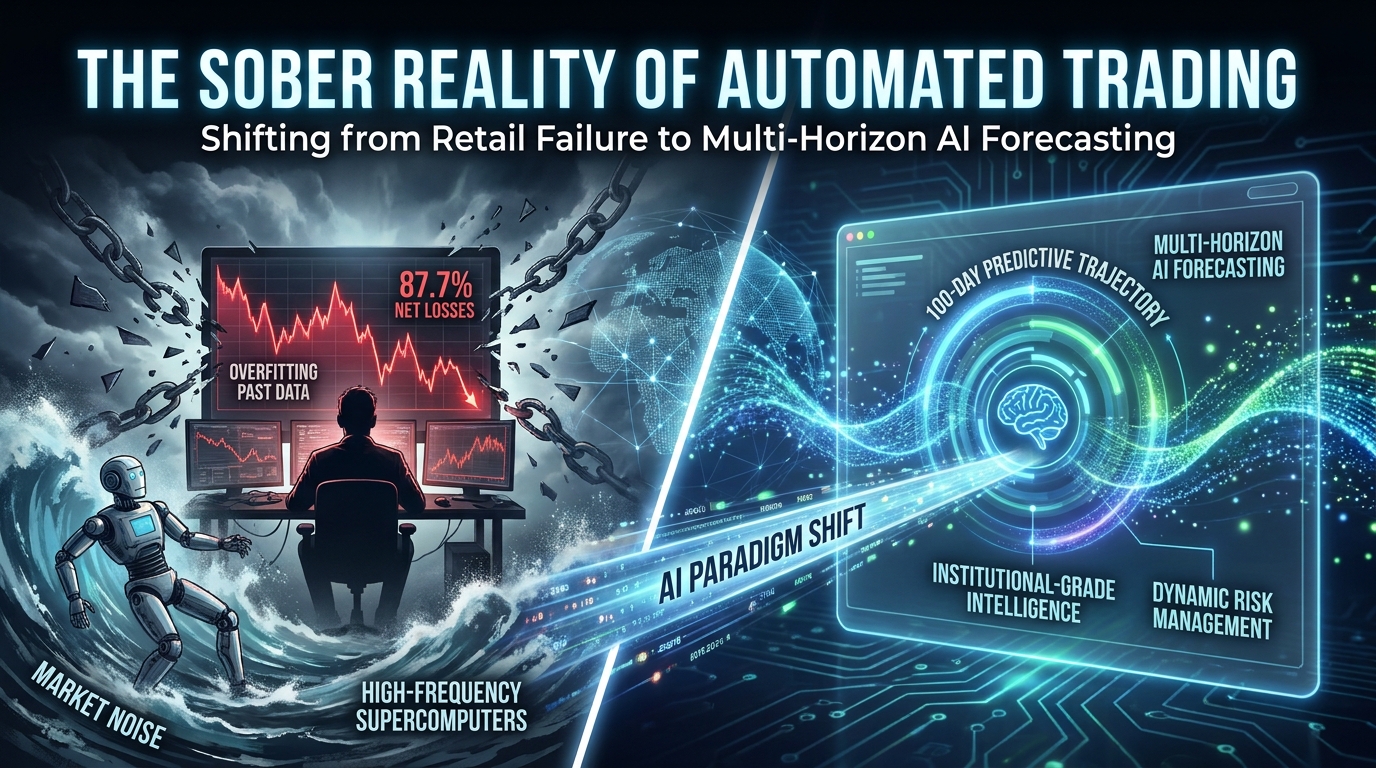
Modern financial markets are characterized by extreme volatility and overwhelming information density, rendering reactive human trading increasingly ineffective. This report details the paradigm shift toward automated daily trading powered by multi-horizon artificial intelligence (AI) time-series forecasting and real-time sentiment analysis. By leveraging foundation models trained on staggering volumes of up to 400 billion real-world data points, systems can project asset trajectories up to 100 days into the future with mathematically defined prediction confidence intervals, often targeting 95% probability. This long-term probabilistic roadmap provides critical context for short-term, sentiment-driven market anomalies. The execution of these strategies requires robust infrastructure, integrating specialized APIs like Interactive Brokers and Alpaca, alongside strict quantitative risk management protocols—such as hard-coded circuit breakers and 2% to 5% daily loss limits—to prevent catastrophic algorithmic errors. Ultimately, the synthesis of long-term AI forecasting and disciplined automated execution transforms trading from an emotional gamble into a systematic, probability-driven enterprise.
- The Volatility Trap: Relying solely on daily price movements often traps investors in a cycle of reactive, emotion-driven decisions.
- The Predictive Advantage: Looking 100 days into the future provides a stabilizing context, transforming chaotic daily dips and spikes into actionable, strategic opportunities.
- The Dual-Engine Approach: True trading intelligence emerges when long-term historical price trajectories are paired with real-time news sentiment analysis.
- Emotionless Execution: Automating the trading process based on these AI insights eliminates human hesitation, ensuring strategies are executed with relentless consistency.
The Modern Trading Dilemma
If you have ever stared at a flashing screen of red and green stock tickers, you understand the mental toll of modern trading. The financial markets generate an overwhelming amount of information every single second. Between social media rumors, sudden geopolitical shifts, unexpected quarterly earnings, and the sheer volume of algorithmic trading dominating the floor, the modern investor is constantly bombarded by noise. For those trading stocks, ETFs (Exchange-Traded Funds), or the never-sleeping cryptocurrency markets, this constant barrage can easily lead to "decision paralysis" or, worse, panic trading. The fundamental problem is that most people trade reactively. They see a price drop, they feel fear, and they sell. They see a price surge, they feel the fear of missing out, and they buy at the top. This reactive cycle is the primary reason why everyday traders struggle to maintain consistent, long-term growth.
The Shift to AI-Assisted Strategy
To survive and thrive in this environment, a paradigm shift is required. We must move away from reacting to what the market did five minutes ago, and instead proactively position ourselves for what the market is likely to do over the coming months. This is where artificial intelligence fundamentally changes the game for the everyday investor. By stepping back and letting advanced algorithms analyze decades of market history alongside real-time human emotion, we can build a comprehensive roadmap. Instead of trying to guess tomorrow's price movement in a vacuum, modern AI systems allow us to map out the likely trajectory of an asset up to 100 days in advance. When you know where the road is generally heading, the daily bumps become much easier to navigate.
Decoding the 100-Day AI Forecast: Your Financial Compass
When we talk about a "100-day forecast," it is easy to imagine a crystal ball that spits out an exact dollar figure for a specific date in the future. In reality, AI forecasting is much more sophisticated and practical than simple fortune-telling. Think of an AI time-series prediction less like a crystal ball and more like a highly advanced weather forecast for the financial markets.
Meteorologists cannot tell you exactly how many drops of rain will fall on your roof three weeks from Tuesday. However, by analyzing vast amounts of historical climate data, current atmospheric pressures, and seasonal trends, they can tell you with high probability (typically utilizing a mathematically rigorous 95% prediction confidence interval) that a storm system is developing and you should prepare for heavy rain [cite: 1, 2, 3]. AI time-series models do the exact same thing for financial assets. They ingest enormous amounts of historical price data—often pre-trained on staggering volumes of 100 billion to 400 billion real-world and synthetic time points, representing decades of tick-by-tick records and recurring cyclical patterns—to generate a "cone of probability" [cite: 4, 5, 6].
These algorithms look for the underlying currents that human eyes simply cannot detect. Instead of imagining a generic scenario, consider a real-world flashpoint: the March 2020 stock market crash triggered by the global pandemic. At the beginning of the crisis, human panic drove massive sell-offs. Microsoft (MSFT) plummeted 14.74% in one day (its largest single-day drop since 2000), and broad indices like the S&P 500 fell by 12% to 13% [cite: 7, 8]. By calculating historical echoes and projecting them forward 100 days, an AI foundation model provides a baseline trajectory that recognizes the underlying resilience of these mega-cap tech stocks, cutting through the static of daily market noise. It mathematically identified that the long-term trend remained intact despite the temporary macro-economic shock. This trajectory acts as your long-term compass. It tells you the overarching trend of the asset.
Real-Time Sentiment: The Daily Rudder
If the 100-day time-series forecast is the compass telling you that the ultimate destination lies to the North, then real-time sentiment analysis is the rudder that helps you navigate the immediate, choppy waves right in front of your boat. A long-term forecast is incredibly valuable, but markets are ultimately made of people, and people are unpredictable, emotional creatures. A sudden news headline, a viral social media post, or a surprising macroeconomic announcement can temporarily completely derail an asset from its historical trajectory.
This is where sentiment analysis comes into play. Modern AI doesn't just crunch numbers; it reads the room. By continuously scanning global news feeds, financial reports, and social platforms, the AI evaluates the "mood" surrounding an asset in real-time. It doesn't just look for mentions of a company's name; it understands context. It knows the difference between a news article stating a company is "aggressively expanding" (positive sentiment) versus "aggressively cutting costs to avoid bankruptcy" (negative sentiment).
The magic happens when you combine the two. Let’s replace the hypothetical with a real scenario. Your 100-day compass shows that a broad market index ETF is in a strong, steady macroeconomic uptrend. However, today, the real-time sentiment rudder detects a sudden spike in negative news—much like the August 5, 2024, global market rout triggered by a weaker-than-expected jobs report, which wiped $1.2 trillion in market value from the "Magnificent Seven" tech stocks in minutes [cite: 9]. Because you have the long-term context, your automated system recognizes this not as a reason to panic and sell, but as a temporary overreaction by human traders—a prime opportunity to buy the dip before the asset returns to its 100-day upward trajectory.
Why Long-Term Context Changes Short-Term Decisions
To truly grasp the power of combining a 100-day forecast with daily execution, we have to look at how context changes everything in trading. A daily price movement in isolation is essentially meaningless. It only gains meaning when placed against a broader backdrop. Let's break down how an AI interprets the exact same daily event differently based on the 100-day outlook.
| Daily Market Event | 100-Day AI Forecast Context | AI-Automated Action | The Underlying Logic |
|---|---|---|---|
| Sudden 10% Price Drop | Strong Upward Trajectory | Buy / Accumulate | The drop is viewed as a temporary market anomaly or emotional panic. The fundamental long-term trend remains intact, making the asset currently "on sale." |
| Sudden 10% Price Drop | Strong Downward Trajectory | Hold / Short | The drop aligns with the predicted macroeconomic weakness. Buying now would be "catching a falling knife." The system waits for true bottom confirmation. |
| Sharp Positive News Surge | Strong Downward Trajectory | Sell / Take Profits | The AI identifies the surge as a "bull trap" (a false signal indicating a declining trend has seemingly reversed, luring in buyers before plummeting again) or temporary hype cycle. The long-term outlook is still bleak, so the system uses the temporary high liquidity to exit positions profitably. |
| Sharp Positive News Surge | Strong Upward Trajectory | Hold / Trail Stop Loss | The news validates the underlying historical model. The system holds the asset to capture maximum upside, while automatically raising safety nets to lock in gains if the trend reverses. |
As the table illustrates, trading without long-term context is like driving blindfolded while only listening to the GPS tell you about the next 10 feet of road. The 100-day forecast removes the blindfold, allowing your trading strategy to anticipate the road ahead rather than just reacting to the potholes.
Navigating 40,000+ Assets Simultaneously
One of the greatest challenges for the everyday trader is diversification. Financial advisors constantly preach the importance of a diversified portfolio—spreading your risk across different sectors, asset classes, and geographies. However, for a human being, manually tracking and analyzing the price history and daily news sentiment for a handful of stocks is a full-time job. Trying to do it for thousands of assets is biologically impossible.
This is where the sheer computational scale of modern AI platforms shines. An automated system doesn't get tired. It can apply the exact same rigorous, multi-horizon time-series forecasting and real-time sentiment scoring to the entire global market simultaneously. This means it can monitor tech stocks in the US, dividend-paying ETFs in Europe, and the highly volatile cryptocurrency markets over the weekend, all without missing a beat. It constantly scans this massive universe to find the perfect setups that align with your specific risk tolerance.
Managing a portfolio across such a massive universe of assets requires robust infrastructure. For those building or integrating these intelligent systems, BAKO API provides the essential financial data and predictive framework, delivering 100-day forecasting trajectories and real-time news intelligence across 40,000+ assets seamlessly. Access to this level of data democratization means that retail investors and independent developers can now utilize the exact same holistic, market-wide viewpoints that were once exclusive to multi-billion-dollar Wall Street hedge funds.
The Mechanics of Automated Execution
Having brilliant insights and accurate predictions is only half the battle. The other half—and arguably the most difficult part for humans—is actually executing the trade. How many times have you known exactly what you should do in the market, but hesitated for a few seconds too long, missing the window of opportunity? Or conversely, how many times have you held onto a losing trade out of pure stubbornness, hoping it would turn around, in direct defiance of your original strategy?
Automated execution takes the human element out of the actual buying and selling process. Here is how a standard, AI-driven daily trading workflow operates in practice, entirely hands-free:
- The Nightly Recalibration: While the trader sleeps, the AI system recalculates the 100-day trajectories for all tracked assets based on the previous day's closing data. It adjusts its probability cones, factoring in any new structural trends.
- The Pre-Market Scan: Hours before the traditional market opens (or continuously for crypto), the sentiment engine scans global news. It looks for overnight developments, earnings leaks, or macroeconomic policy shifts that might cause volatility at the opening bell.
- Strategy Alignment: The system checks these fresh insights against the user's predefined rules. (e.g., "Only buy tech ETFs if the 100-day forecast is positive AND today's news sentiment is neutral or better.")
- Dynamic Sizing and Routing: If an opportunity is found, the system calculates exactly how much to buy based on current portfolio risk. It doesn't bet the whole farm on one trade; it uses dynamic position sizing to ensure the portfolio remains balanced. It then automatically sends the order to the broker. In a professional automated architecture, this is executed via specialized routing hubs and brokerage APIs—such as Interactive Brokers (which offers broad multi-market access and deep execution controls), Alpaca (a cloud-native REST and WebSocket API favored for its seamless zero-commission US stock execution), or Tradier [cite: 10, 11, 12].
- Continuous Risk Management: Once the trade is live, the AI doesn't just walk away. It continuously monitors the asset. If the real-time sentiment suddenly tanks due to breaking negative news, the system can automatically trigger a safety sell (a stop-loss) before the human trader has even read the headline.
Human Psychology vs. Machine Discipline
To truly appreciate the value of AI in daily trading, we must talk about behavioral finance—the study of how human psychology influences financial decisions. Humans are remarkably bad at trading. We are evolutionarily hardwired to seek immediate rewards and to panic in the face of sudden threats. These survival instincts, which kept us alive in the wilderness, are actively detrimental to building wealth in modern financial markets.
We suffer from confirmation bias, actively seeking out news that validates our current trades while ignoring warning signs. We suffer from loss aversion, feeling the pain of losing $100 twice as intensely as the joy of making $100, which causes us to hold onto losing positions in the desperate hope we can just "break even."
An AI system possesses none of this evolutionary baggage. An algorithm does not feel pride when a stock goes up, nor does it feel despair when a cryptocurrency crashes. It operates purely on the logic of its 100-day forecast and the mathematics of its risk parameters. If a strategy dictates that an asset should be sold if it drops 4%, the system sells it at exactly 4.00%. It does not wait to see if it bounces back. It does not go on social media to seek reassurance. It simply executes the plan.
For the everyday investor, delegating this execution to a machine offers a profound psychological benefit. It separates the stress of decision-making from the stress of execution. You can spend your time thoughtfully designing your overarching strategy, selecting your risk tolerance, and choosing the sectors you want to be exposed to, during quiet, unhurried moments. Once the strategy is set, you hand the keys over to the automated system to deal with the chaos of the live market.
Failsafes and Circuit Breakers: Preventing Algorithmic Disasters
While the benefits of automated, emotionless execution are profound, one must immediately address the next logical question: What prevents the AI from executing a catastrophic string of trades if it ingests fake news, bad data, or encounters a flash crash? The absence of human hesitation is a double-edged sword; algorithms can execute ruinous decisions at millisecond speeds if left unchecked. A historical cautionary tale is the 2012 Knight Capital disaster, where a rogue algorithmic deployment executed millions of unintended orders without a functional kill switch, resulting in a staggering $440 million loss in just 45 minutes [cite: 13].
To prevent such anomalies, professional automated trading architectures rely on multi-tiered pre-trade risk filters and hard-coded circuit breakers. These protective mechanisms function as automated kill switches, halting trading activity when specific loss thresholds, volatility conditions, or system errors occur [cite: 14]. Foundational to this risk management are maximum daily drawdown limits, typically strictly capped between 2% and 5% of the total account equity [cite: 15, 16]. If a cascading market dislocation causes the portfolio to hit this limit, the circuit breaker instantly severs the connection to the exchange, overriding any AI trade signals for the remainder of the session.
Additionally, systems employ consecutive loss limits (e.g., pausing the algorithm after 3 to 5 consecutive losing trades) and maximum overarching drawdown caps (often halting all activity if the account equity drops 5% to 10% from its peak balance) [cite: 15]. Advanced infrastructures also require an out-of-band "dead-man trigger"—an independent watchdog daemon that monitors the system and can send cancel-all commands via a completely separate API key if the primary execution engine behaves erratically [cite: 13]. These rigorous failsafes ensure that the machine's discipline protects capital even when the data inputs become chaotic.
Structuring a Resilient Portfolio
When you combine long-term AI forecasting, real-time sentiment tracking, and automated execution across tens of thousands of assets, you fundamentally change how you construct a portfolio. Traditional investing often relies on the "buy and hold" strategy—buying a basket of index funds and holding them for 30 years, riding out all the brutal market crashes along the way. Active day trading sits at the opposite extreme—buying and selling wildly based on minute-by-minute chart patterns.
The AI-driven approach creates a powerful middle ground: Dynamic Proactive Management.
"The goal is not to predict the future with 100% certainty; the goal is to consistently align your capital with mathematical probabilities rather than human emotions."
With a 100-day forecast horizon, your portfolio becomes a living, breathing entity. If the AI detects that the long-term forecast for the technology sector is steadily deteriorating while the forecast for utilities and healthcare is strengthening, it can slowly and automatically begin rotating your capital over a period of weeks. It doesn't make sudden, jerky movements; it smoothly transitions your exposure based on the shifting probabilities of the 100-day compass.
Furthermore, the inclusion of uncorrelated assets like cryptocurrency provides a unique stabilizing mechanism. While traditional stocks are highly vulnerable to central bank interest rate decisions and national economic reports, cryptocurrencies often march to the beat of their own drum. By feeding both traditional fiat-based assets and digital currencies into the same unified AI brain, the system can find hedging opportunities that a human might never consider. If a massive tech sell-off is predicted—comparable to the March 2020 crash where the S&P 500 abruptly dropped by 12% to 13% and oil prices collapsed [cite: 8]—the AI might find a safe harbor in a specific subset of low-volatility ETFs or temporarily shift capital into stablecoins (cryptocurrencies designed to have a relatively stable price, typically by being pegged to a fiat currency like the US Dollar or regulated by an algorithm), waiting for the storm to pass.
The Future of Everyday Investing
We are standing on the edge of a massive democratization in finance. For decades, the kind of multi-horizon time-series forecasting and automated sentiment analysis discussed here was locked behind the closed doors of elite quantitative hedge funds. They had the supercomputers, the armies of math PhDs, and the direct data feeds required to build these models.
Today, thanks to the explosion of cloud computing and the availability of sophisticated financial APIs, that barrier to entry has completely dissolved. The everyday investor now has the ability to sit at their kitchen table and deploy automated trading strategies that look 100 days into the future, process global news in milliseconds, and execute trades without a single drop of human hesitation.
The transition from a reactive trader to a proactive investor requires a shift in mindset. You have to stop trying to outguess the immediate noise of the market and start trusting the long-term mathematical trajectories. You have to recognize that the 24-hour news cycle is largely a distraction, designed to generate clicks rather than wealth. By anchoring your strategy to the steady, logical predictions of AI time-series models, and using automated execution to protect yourself from your own emotional instincts, you stop fighting the market chaos and start systematically navigating it.
More from BAKO Blog

Laravel Authentication with Azure Active Directory
The AI Paradigm Shift in Algorithmic Trading

The New Era of Algorithmic Alpha: AI Time-Series Forecasting in Daily Trading

Deconstructing AI Time-Series Forecasting in Daily Trading

The Architecture of Dynamic Asset Allocation: AI-Driven Time-Series Forecasting for Daily Trading

Automated Daily Trading: The Convergence of AI Time-Series Predictions and Market Sentiment

The Future of Algorithmic Trading: Zero-Shot AI and Multivariate Forecasting
