 BAKO
The AI Paradigm Shift in Algorithmic Trading
2026-11-25
Disclaimer: The following content is for informational and architectural purposes only and does not constitute financial, investment, or trading advice. Trading in financial markets carries significant risk, and forecasts are statistical estimates, not guarantees.
Executive Summary
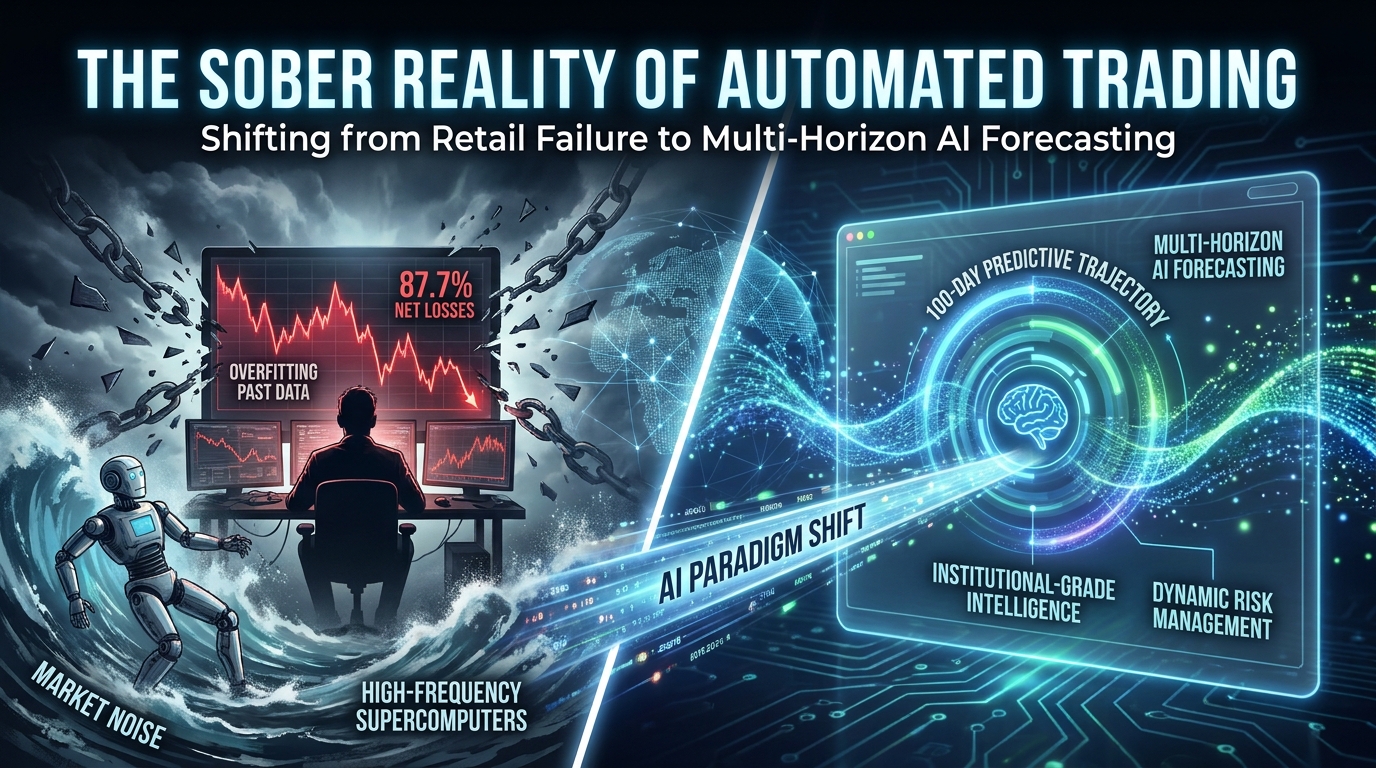
The pursuit of automated trading success requires confronting a harsh reality: 87.7% of individual traders suffer net losses over a given year, while professional institutions capture 99% of the gross profits in algorithmic markets [cite: 1, 2]. Traditional retail algorithms fail largely because they overfit past data and attempt to compete on microscopic timeframes against high-frequency trading supercomputers. To survive and thrive, the modern paradigm is shifting toward multi-horizon AI forecasting. By leveraging advanced foundation models to generate 100-day predictive trajectories, developers can bypass market noise, synthesize complex alternative data, and deploy dynamic risk management strategies that align with institutional-grade architectures.
The dream of automated trading is incredibly alluring: set up a smart algorithm, let it run quietly in the background, and watch the profits roll in while you go about your day. Yet, behind the glamorous social media success stories lies a much more sobering reality. Research consistently suggests that a substantial majority of everyday individuals running their own automated trading software fail to produce sustained, long-term positive returns [cite: 3]. While algorithmic and high-frequency trading accounts for the vast majority of order flow and institutional success in modern liquid markets, the everyday trader often finds themselves trapped in a cycle of over-leveraged losses and broken strategies [cite: 3]. However, the landscape is shifting. The emergence of multi-horizon artificial intelligence and deep-learning forecasting is finally offering a bridge across this divide. While there is no magic formula that guarantees profit without risk, understanding exactly why traditional retail algorithms fail is the first step to leveraging next-generation AI to level the playing field.
The Sobering Reality of Algorithmic Trading
To truly understand how to succeed in automated trading, we first have to look at the numbers. It is a common misconception that simply removing human emotion through code will automatically lead to profitability. In reality, the financial markets are fiercely competitive environments, and the data paints a very clear picture of who is actually winning.
Recent studies from major financial regulators highlight the stark contrast between professional institutions and individual traders in the derivatives and algorithmic space.
| Trader Category | Market Insight & Statistic |
|---|---|
| Individual Traders (India Equity Derivatives) | A massive study revealed that 87.7% of individual traders made a net loss over a one-year period [cite: 1]. |
| Retail Leveraged Accounts (UK Brokers) | Between 51% and 82% of retail accounts trading leveraged contracts (manual and automated) consistently lose money [cite: 1]. |
| Professional Institutions | Firms utilizing institutional algorithmic orders captured 99% of the gross profits among foreign investors and proprietary trading firms [cite: 1, 2]. |
What these numbers tell us is that automation alone is not an edge. When an individual trader builds a basic algorithm, they are stepping into a ring with massive quantitative funds that possess better data (often processing terabytes of alternative tick and sentiment data daily), faster execution (operating with microsecond or even nanosecond latency), and far more sophisticated risk management. The profits in algorithmic trading overwhelmingly flow toward institutions that treat trading as a rigorous data science, rather than a get-rich-quick scheme [cite: 1, 2].
Why Traditional Retail Algorithms Break Down
If everyday traders have access to the same historical price charts as the professionals, why do their automated systems fail so frequently? The answer lies in a combination of technical traps and psychological missteps that quietly erode a trading account over time.
The Trap of the Lowest Timeframes
Many beginners are drawn to the chaotic action of the lower timeframes, such as one-minute or five-minute charts, hoping to scalp tiny profits hundreds of times a day. But this is exactly where retail traders are at the greatest disadvantage. Trading on these microscopic timeframes means competing directly against high-frequency trading (HFT) firms that spend millions of dollars to physically locate their servers closer to the exchange [cite: 4]. On a five-minute chart, you are largely trading random market noise. Furthermore, the small profit margins on these rapid trades are easily eaten alive by transaction costs, exchange fees, and "slippage"—the difference between the expected price of a trade and the price at which it is actually executed [cite: 2, 4].
Overfitting: Memorizing the Past Instead of Predicting the Future
Another massive hurdle is the concept of "overfitting." When a trader builds a strategy, they test it against past market data. It is very tempting to keep tweaking the rules of the algorithm until it shows a flawless, highly profitable history. However, doing this essentially forces the algorithm to memorize the past rather than learn the underlying dynamics of the market [cite: 5]. When an overfitted algorithm is finally turned on in the live market—where conditions are completely new and unpredictable—it falls apart immediately, systematically losing money with every trade [cite: 3, 5].
The Misunderstanding of Success Metrics
Finally, many people build algorithms optimized solely for massive returns, completely ignoring the psychological and operational terror of "drawdowns" (the percentage drop from a peak in account value). A strategy that generates a 30% annual return but routinely suffers a terrifying 50% drop in account value will almost always cause a trader to panic and turn the machine off at the worst possible moment [cite: 3]. A far more successful and sustainable approach is a strategy that yields a modest 15% return with only an 8% drawdown. It is emotionally easier to manage, operationally safer, and significantly more durable in the long run [cite: 3].
The AI Paradigm Shift: Zooming Out with Multi-Horizon Forecasting
To break free from the cycle of overfitting and low-timeframe noise, modern automated trading is shifting away from rigid, rule-based coding and moving toward deep-learning artificial intelligence. Specifically, the biggest breakthrough is happening in the realm of "multi-horizon time-series forecasting."
Historically, if an algorithm wanted to guess the price of an asset, it would look at today's price and try to predict tomorrow's. If it wanted to predict a week ahead, it would have to guess tomorrow, use that guess to predict the next day, and so on. This step-by-step guessing creates a snowball effect where tiny errors compound rapidly, rendering long-term predictions useless [cite: 6].
Modern AI pre-trained foundation models (massive, generalized AI systems designed to adapt to a wide variety of tasks without needing to be built from scratch) completely flip this process. By processing decades of tick-level historical data comprising millions of individual data points all at once, these models generate an entire forecast window in a single pass. For example, rather than iteratively guessing one day at a time, the AI looks at the historical market action and instantly outputs a complete, 100-day future trajectory [cite: 6, 7]. This dynamic map of the future provides traders with both a projected price and a confidence interval for every single day over a long horizon [cite: 8, 9].
This allows trading systems to look past the random noise of a five-minute chart. Short-term forecasts (1 to 5 days) help the system react to immediate momentum, while the longer-term forecasts (20 to 100 days) ensure that the system isn't trading against the overarching, stabilizing trend of the market [cite: 10]. It forces the automated system to act more like a seasoned portfolio manager and less like a chaotic day trader.
To ground this in reality, consider a complex macroeconomic event: if geopolitical tensions unexpectedly rise in a major oil-producing region, the AI doesn't just look at the historical price chart of crude oil. It synthesizes the real-time news sentiment of the breaking geopolitical event, correlates the immediate spike in global oil prices, and simultaneously forecasts the downstream negative impact on commercial airline stocks due to rising jet fuel costs—adjusting the multi-horizon trajectories for all interconnected assets across the ecosystem instantly. This multi-horizon approach effectively replaces the erratic volatility of historical point-tracking with a smooth, probability-bounded "cone of uncertainty" that maps a mathematically calculated 100-day future trajectory.
Leveling the Playing Field with Turnkey Intelligence
In the past, building an AI capable of digesting global market data and generating 100-day trajectories required a team of data scientists and millions of dollars in computing power. Today, cloud architecture and pre-trained foundation models have democratized this technology. The AI is natively trained to recognize complex, multivariate scenarios—meaning it can look at how a stock, a commodity, and broader market sentiment all influence each other simultaneously, without needing an everyday user to manually code those relationships [cite: 8].
For developers, traders, and product engineers looking to integrate this institutional-grade intelligence without building models from scratch, leveraging a dedicated infrastructure is crucial. Systems can seamlessly pull these insights by using BAKO API as a financial data and ML prediction platform providing 100-day forecasting trajectories and market intelligence across 40k+ assets. Specifically, the API acts as a secure architectural bridge for this predictive data, operating on a highly scalable tier model: it offers a free developer tier (allowing 100 calls per day), a Pro tier (at €20/month for 10,000 calls), and an Enterprise tier for unlimited usage [cite: 7, 11]. This setup provides a vital real-world context: it is ideal for quantitative engineers and backend developers building their own institutional-grade trading bots. Conversely, its anti-use cases must be clearly defined: it is explicitly not meant for casual retail traders looking for a simple point-and-click graphical interface, nor is it designed for ultra-high-frequency scalpers who require sub-millisecond local execution directly at the exchange [cite: 12]. By utilizing enterprise environments under the hood, these platforms handle the heavy computational lifting, providing zero-shot forecasting (the ability of an AI to accurately predict outcomes for completely new scenarios or assets it hasn't explicitly seen before) and real-time news sentiment scoring through a simple connection [cite: 8, 10].
Building for Sustainability
Automated trading is not a shortcut to instant wealth; it is a serious discipline that requires realistic expectations and robust risk management. The vast majority of retail algorithms fail because they are built on fragile, over-optimized rules attempting to beat supercomputers at a micro-second game.
By shifting focus away from rigid rules and adopting AI-driven, multi-horizon forecasts, modern trading systems can finally step back and see the bigger picture. When you combine the predictive power of a 100-day AI forecast with strict risk management—trading smaller position sizes and accepting modest, steady growth—you transition from gambling on market noise to systematically navigating the financial future.
But how exactly does a trader mathematically tie an AI's output to their position size? The answer lies in the AI's confidence interval. Advanced traders dynamically adjust their risk exposure based on the width of the forecast's probability band. If the AI outputs a narrow, high-confidence trajectory, the automated system might allocate a larger position using a dynamic mathematical model like the Kelly Criterion. If the forecast band is wide and uncertain due to market volatility, the system defaults to a conservative fixed-fractional model, aggressively reducing the position size to a mere fraction of a percent. This strict mathematical marriage of AI probability and disciplined risk allocation is the true cornerstone of sustainable, long-term automated trading.
More from BAKO Blog

Laravel Authentication with Azure Active Directory

The Impact of Generative AI on Modern Home Design

The Future of Algorithmic Trading: Zero-Shot AI and Multivariate Forecasting

The AI Paradigm Shift in Architecture: Generative Floor Plans and 3D Visualization

The New Era of Algorithmic Alpha: AI Time-Series Forecasting in Daily Trading

The Paradigm Shift to Continuous Modeling: Deconstructing SIRENs and Implicit Neural Representations

From ReLU to SwiGLU: The Paradigm Shift in LLM Feed-Forward Networks
