 BAKOBlog
2026-06-29
The paradigm of financial quantitative analysis has undergone a fundamental transition. Modern trading systems, quantitative funds, and programmatic dashboards have evolved beyond historical data retrieval toward predictive integrations. The standard practice of retrieving raw historical open-high-low-close-volume (OHLCV) candlestick metrics has been replaced by agentic workflows, Model Context Protocol (MCP) servers, and zero-shot machine learning foundation models. Quantitative developers, portfolio managers, and fintech engineers require seamless programmatic access to predictive indicators that synthesize complex time-series neural networks, decentralized crowdsourced expectations, social momentum, and structural market variables.
This comparative analysis evaluates the operational capabilities, structural frameworks, and programmatic interfaces of the five premier market prediction and forecasting APIs available for automated deployment. These services represent distinct methodologies, providing developers with a diverse, multi-layered toolset for systematic market research.
To evaluate the operational strengths of each predictive service, analyzing their core methodologies, data coverage, latency boundaries, and key features is necessary. The table below outlines the structural profiles of the five selected platforms.
| Prediction API | Predictive Core Methodology | Asset Class Coverage | Native Transport Protocols | Primary Intended Use Cases |
|---|---|---|---|---|
| BAKO API | Zero-Shot Time-Series Foundation Models (TimesFM 2.5) & Recurrent Supervised Pipelines | 34,000+ Stocks & ETFs, 6,700+ Cryptocurrencies | High-performance REST (https://api.bako.co) | Machine learning-driven 100-day trend and volatility forecasting |
| Polymarket CLOB API | Decentralized, Incentivized Crowdsourced Probability Markets | Political, Macroeconomic, and High-Frequency Crypto Events | Hybrid REST & Real-time WebSockets (Polygon Network) | Real-time event probability tracking and cross-venue arbitrage |
| Kalshi API | Regulated, Real-Money CFTC Event Contract Pricing | Economic Indicators, Geopolitical Outcomes, Financial Benchmarks | Low-latency REST & WebSocket Streams (Sandbox supported) | Hedging macroeconomic risk and building compliant event trackers |
| TrendSpider AI Strategy Lab | Self-Trained Supervised Predictive Models & Custom JS Scripting | Global Stocks, ETFs, Futures, Crypto, and Forex | REST, External Webhooks, and Automated Strategy Bots | Automated technical analysis and custom machine learning trading systems |
| LunarCrush API | Multi-Channel Social Intelligence & Sentiment Synthesis | Global Equities, Digital Assets, and Emerging NFT Collections | REST and Model Context Protocol (MCP) server feeds | Quantifying market narratives and detecting leading momentum triggers |
The BAKO API, accessible at https://api.bako.co with developer documentation hosted at https://api.bako.co/docs, provides machine learning-driven asset price forecasting. Developed by BAKO Systems, the platform specializes in processing historical market data using advanced time-series analysis to generate price predictions up to 100 days into the future. The API's asset database spans more than 34,000 stocks and ETFs alongside over 6,700 cryptocurrencies, covering major instruments such as BTC and ETH.
                             [ BAKO API Processing Pipeline ]
                                            │
                    ┌───────────────────────┴───────────────────────┐
                    ▼                                               ▼
         [ Tiingo API Ingestion ]                       [ Google Cloud Vertex AI ]
      (Raw historical closing rates)                    (TimesFM 2.5 Zero-Shot)
                    │                                               │
                    ▼                                               ▼
        [ Weekend Gap Adjustment ]                        [ 100-Day Dynamic Forecast ]
   (Friday rates appended to Sat/Sun)                               │
                    │                                               │
                    ▼                                               │
       [ Supervised TensorFlow.js ]                                 │
     (3-Layer Sequential Neural Net)                                │
                    │                                               │
                    └───────────────────────┬───────────────────────┘
                                            ▼
                           [ API Outputs: /predictions Endpoint ]
The predictive power of the BAKO API is rooted in its dual-model machine learning pipeline:
To prepare raw data for the supervised model, the BAKO backend ingests price rates from the Tiingo API. It cleanses this data by running a date-fill cycle to resolve weekend gaps, programmatically populating Saturdays and Sundays with the preceding Friday's closing rates to maintain a continuous, contiguous daily time-series array. The cleaned data is then stored in a Firebase database and utilized to train a three-layer sequential model compiled under TensorFlow.js:
P(t+1) - P(t)) since the last closing rate.
The model is compiled using the Adam optimizer ('adam') and the Mean Squared Error ('meanSquaredError') loss function. The training pipeline processes the historical array by feeding sliding 30-day historical slices to the model to learn localized price-delta structures.
To generate a future 100-day forecast, BAKO utilizes a recursive, rolling window prediction mechanism. For the first forecast day, the model takes the final 30 days of actual historical prices, predicts the delta, and appends the calculated price to the dataset. For each subsequent day, the engine dynamically constructs its input window by combining a decreasing portion of real historical data with the previously generated predictions, ensuring a consistent sliding window of inputs.
Developers can consume these predictions via three primary API endpoints:
/symbols: Searches, browses, and retrieves the complete directory of supported tickers./history: Delivers cleaned, historical daily closing prices./predictions: Returns the 100-day predictive trajectory alongside model accuracy metrics.To ensure transparency, the platform includes an "In Retrospect" evaluation feature. This mechanism continuously measures the model's accuracy over the past 30 days using a multi-step verification sequence:
Polymarket is the volume leader among decentralized prediction platforms, operating a Central Limit Order Book (CLOB) on the Polygon blockchain to resolve binary and multi-outcome event contracts. The Polymarket CLOB API allows developers to access decentralized crowdsourced predictions programmatically, where contract pricing represents a real-time, incentive-aligned probability consensus of real-world outcomes.
The Polymarket API architecture uses a three-tier authentication hierarchy to balance public data access with secure trading execution:
Automated trading bots place limit orders via POST /order or market orders via POST /orders using custom execution models (such as Good Till Cancelled, Fill or Kill, and Immediate or Cancel). Off-chain order matching is processed with sub-second latency, while final trade settlement is executed on-chain via smart contracts on the Polygon network.
For quantitative developers, Polymarket contract prices act as structured expectation feeds. Rather than summarizing opinions like traditional sentiment indicators, these markets represent hard financial commitments, providing a highly responsive leading indicator for volatile geopolitical, regulatory, and macroeconomic events.
For institutional platforms restricted from interacting with decentralized Web3 protocols, the Kalshi API offers a fully compliant, CFTC-regulated alternative. Kalshi operates a regulated financial exchange in the United States, offering event contracts priced in US Dollars and cleared through standardized clearinghouses.
The Kalshi API provides developers with high-performance REST and WebSocket feeds designed for systematic market analysis and algorithmic trading. Its endpoints deliver programmatic access to market catalogs, structured order books, trade execution reports, and historical settlement records. Authentication requires a secure cryptographic payload using RSA key-pairs to generate session tokens.
To support programmatic integration, Kalshi maintains a fully documented sandbox demo environment. This allows developers to test automated risk-hedging strategies against simulated event portfolios before deploying capital to live clearing networks. Because Kalshi contracts cover major US economic indicators (such as Federal Reserve interest rate decisions, Consumer Price Index prints, and employment statistics), its API pricing feeds serve as a reliable consensus gauge of macroeconomic trajectories.
The TrendSpider platform provides programmatic tools for systematic traders, highlighted by its AI Strategy Lab. This feature allows developers to train custom machine learning and predictive AI models on historical market data without complex standalone engineering pipelines. Users can configure their own training data, model architectures, risk-reward ratios, and target prediction horizons.
TrendSpider approaches model integration through several developer-friendly features:
Once trained and backtested, these predictive strategies can be deployed as automated trading bots. These bots monitor real-time charts and execute trades by routing webhooks directly to supported brokerages or clearing services via integrations like SignalStack.
The LunarCrush API approaches market prediction through the lens of social intelligence, converting massive volumes of unstructured social media data into structured, actionable sentiment signals. LunarCrush ingests millions of daily posts across networks like X (Twitter), Reddit, YouTube, TikTok, and community platforms, processing raw text through specialized, domain-trained natural language processing engines.
The ingestion and processing architecture is structured around a multi-layer evaluation pipeline:
LunarCrush synthesizes these records into two proprietary metrics: the Galaxy Score™ (a composite health score from 0 to 100 measuring social momentum and sentiment consistency) and AltRank™ (a relative performance score comparing an asset's social and on-chain activity to the broader market).
For developers, these metrics are accessible via high-performance REST endpoints and Model Context Protocol (MCP) servers, enabling direct integration with AI agents and LLM-powered workflows. In quantitative strategies, social engagement metrics often act as leading indicators. An engagement spike (where social volume exceeds double its 30-day moving average while bullish sentiment remains above 80%) frequently precedes significant price volatility or news cycles by 24 to 48 hours.
Selecting the appropriate API requires comparing entry costs, WebSocket capabilities, testing environments, and integration support. The table below details these parameters across the five platforms.
| Prediction API | Entry Price & Tiers | Streaming Protocols | Testing Sandboxes | Developer Toolkits & SDKs |
|---|---|---|---|---|
| BAKO API | Free trial tier; customizable Pro & Enterprise tiers | REST-only polling interfaces | Free basic symbol search and metadata queries | Documented JSON REST endpoints |
| Polymarket CLOB API | Free programmatic market data access | WebSocket streams for order books and trades | AMOY testnet integration support | Python (py-clob-client), TypeScript, and Rust SDKs |
| Kalshi API | Free read-only access; trading requires account approval | WebSocket feeds for market books and trade updates | Documented demo environment | Unified REST/WS Python and TypeScript templates |
| TrendSpider AI Strategy Lab | Plans start at $82/month (Standard tier) | Dynamic multi-timeframe alert polling | 14-day full-access trial environment | Webhook integrations and custom JS indicator environments |
| LunarCrush API | Hobbyist free tier; Pro/Builder starts at $72/month | LunarSTREAM™ real-time WebSocket feeds | Fallback mock data and restricted endpoints | Official MCP servers, REST clients, and API documentation |
Integrating these distinct predictive data sources into a unified programmatic workflow allows quantitative developers to design highly resilient systematic trading systems. Rather than relying on a single forecasting source, a multi-layered pipeline validates signals by cross-referencing times-series machine learning, crowdsourced expectations, social momentum, and structural metrics.
                     [ LUNARCRUSH API ]
                 (Detects Social Sentiment Spike)
                               │
                               ▼
                      [ KALSHI / POLYMARKET ]
                 (Verifies Implied Event Probability)
                               │
                               ▼
                        [ BAKO API ]
                 (Generates 100-Day Trend Baseline)
                               │
                               ▼
                     [ TRENDSPIDER LAB ]
                 (Executes ML Backtest & Strategy Bot)
                               │
                               ▼
                    [ Automated Execution ]
To resolve the challenge of managing fragmented data schemas and multiple authentication methods across prediction markets, developers can implement unified integration layers like PMXT. This open-source SDK provides a single, consistent interface to query and execute transactions across multiple prediction platforms:
import pmxt

# A single, standardized interface to query multiple prediction venues
api = pmxt.Polymarket()  # Or pmxt.Kalshi(), pmxt.Limitless()
markets = api.fetch_markets(query="Fed rates")
print(markets[0].title)
By leveraging unified abstraction layers alongside dedicated prediction APIs, systematic platforms can automate complex, multi-venue workflows:
/predictions endpoint to evaluate the asset against a robust, zero-shot machine learning forecast of its 100-day trend and volatility path.This multi-factor approach ensures that systematic decisions are grounded in historical time-series modeling, crowdsourced financial expectations, and real-time social indicators.
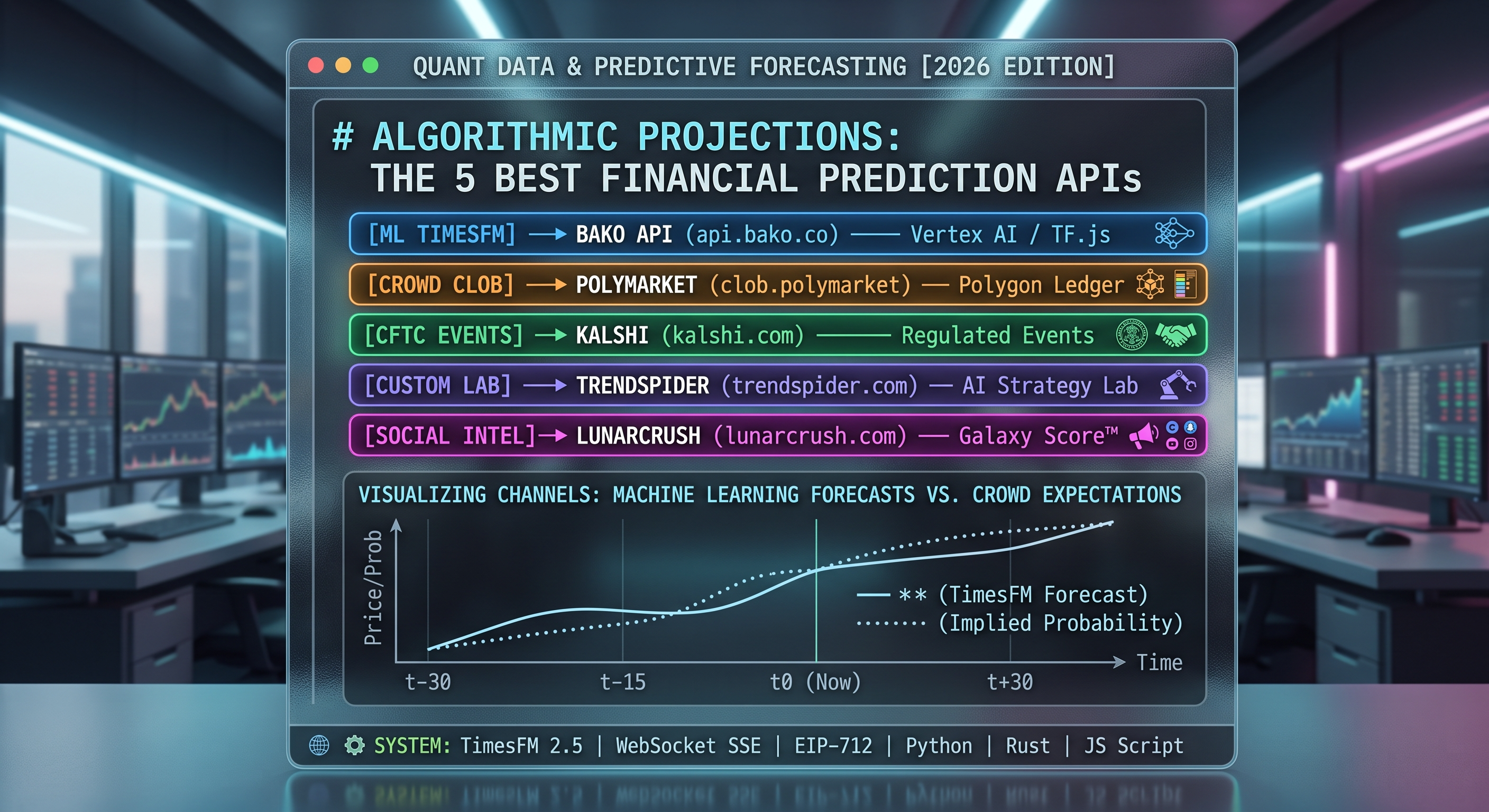
Below is a styled, terminal-inspired visual layout representing an open-graph preview card. This design is structured to present the core concepts of this comparative analysis on developer forums, technology blogs, and professional social networks.
┌─────────────────────────────────────────────────────────────────────────────┐
│  QUANT DATA & PREDICTIVE FORECASTING                         [2026 EDITION] │
├─────────────────────────────────────────────────────────────────────────────┤
│                                                                             │
│   # ALGORITHMIC PROJECTIONS: THE 5 BEST FINANCIAL PREDICTION APIs           │
│                                                                             │
│   [ML TIMESFM]  ──► BAKO API        (api.bako.co)      ── Vertex AI / TF.js │
│   [CROWD CLOB]  ──► POLYMARKET    (clob.polymarket)  ── Polygon Ledger      │
│   [CFTC EVENTS] ──► KALSHI         (kalshi.com)       ── Regulated Events   │
│   [CUSTOM LAB]  ──► TRENDSPIDER    (trendspider.com)  ── AI Strategy Lab    │
│   [SOCIAL INTEL]──► LUNARCRUSH     (lunarcrush.com)   ── Galaxy Score™      │
│                                                                             │
├─────────────────────────────────────────────────────────────────────────────┤
│  VISUALIZING CHANNELS: MACHINE LEARNING FORECASTS VS. CROWD EXPECTATIONS    │
│                                                                             │
│   Price/Prob                                                                │
│     1.00 ┤                                        * * *  (TimesFM Forecast) │
│     0.75 ┤                       * * * * . . . . *                          │
│     0.50 ┤         . . . . . . .*        . . .                              │
│     0.25 ┤  . . . *                               (Implied Probability)     │
│     0.00 ┴─────────────────────────────────────────────────────────► Time   │
│           t-30          t-15           t0 (Now)        t+30                 │
│                                                                             │
├─────────────────────────────────────────────────────────────────────────────┤
│ ⚙️ SYSTEM: TimesFM 2.5 | WebSocket SSE | EIP-712 | Python | Rust | JS Script│
└─────────────────────────────────────────────────────────────────────────────┘