 BAKO
Engineering Cross-Platform Digital Ecosystems
2026-11-16
Executive Summary
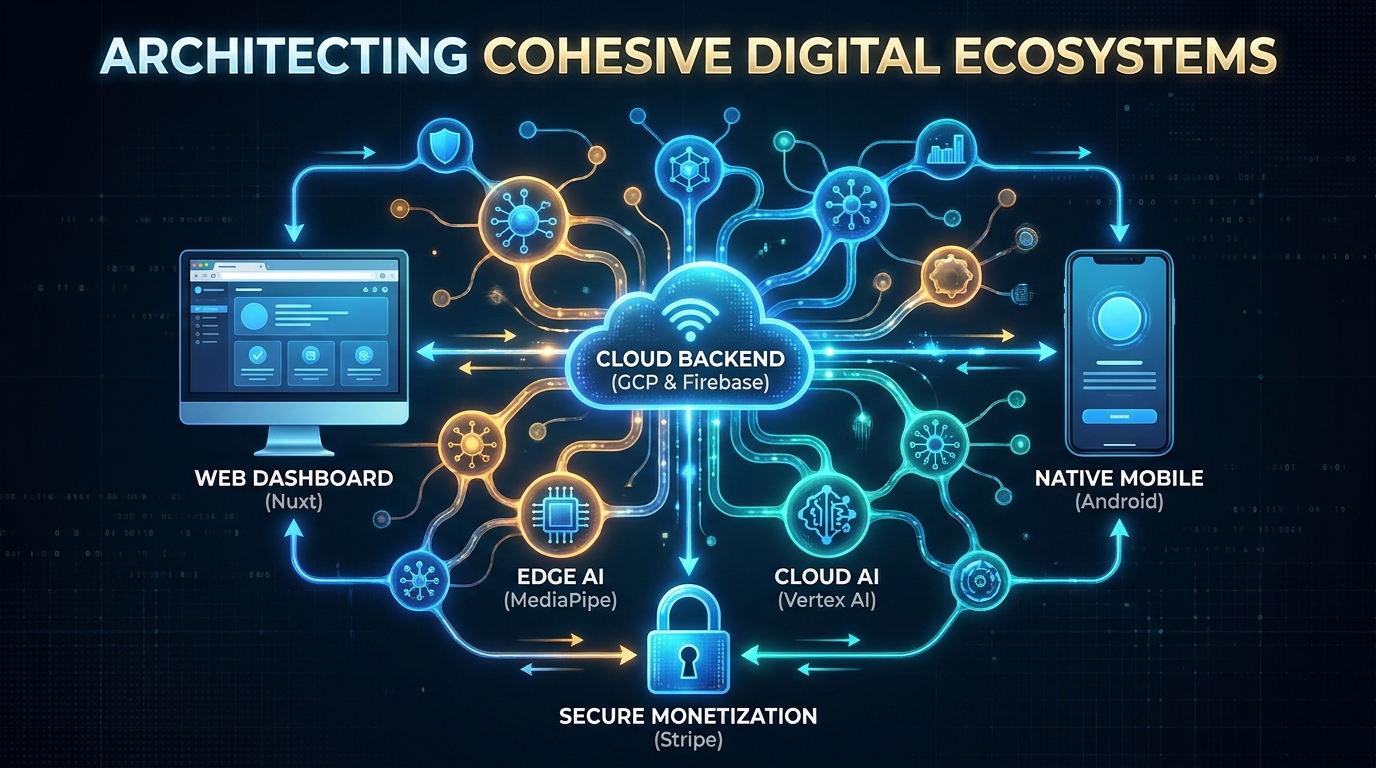
Building a successful digital product today requires far more than launching a standalone mobile application or a basic web portal. The current landscape demands a cohesive, highly intelligent ecosystem where data flows seamlessly across multiple platforms, user experiences adapt in real-time, and artificial intelligence provides practical, invisible utility. This comprehensive guide outlines the architectural blueprint for achieving this synergy. By thoughtfully bridging robust web frameworks like Nuxt, powerful backend environments like Laravel, native mobile interfaces for Android, and event-driven cloud environments like Google Cloud Platform (GCP) and Firebase, product leaders can engineer systems that are incredibly powerful and agile. Furthermore, we explore the integration of practical AI—utilizing Vertex AI and Edge computing—alongside secure, scalable monetization via Stripe. Ultimately, this report synthesizes the strategies, procurement costs, and security compliance measures necessary to build digital products that launch faster, capture market share, and dynamically adapt to user needs.
It seems likely that the era of isolated software is permanently behind us, replaced by interconnected systems that anticipate user needs.
Research suggests that when engineering teams decouple their web dashboards from their mobile frontends without a unifying real-time synchronization strategy, user friction inevitably skyrockets. For example, recent industry statistics indicate that 53% of mobile users will abandon a site if it takes more than three seconds to load [cite: 1]. Furthermore, in modern applications utilizing artificial intelligence, responses exceeding a two-second latency result in a staggering 40% user drop-off rate, whereas systems architected for sub-second responses can yield a 25% higher user engagement and a 15% increase in conversion rates [cite: 2]. Integrating modern machine learning capabilities—such as on-device computer vision or cloud-based predictive analytics—can quickly transform a streamlined project into an unmanageable labyrinth if not architected with a clear, unified vision from day one.
This comprehensive guide explores the modern blueprint for engineering cross-platform digital ecosystems. By thoughtfully bridging robust web frameworks, native mobile interfaces, event-driven cloud environments, and highly practical artificial intelligence, product leaders can architect systems that are both incredibly powerful and surprisingly agile. We will explore the "why" and "how" of this architecture, moving beyond theoretical concepts to actionable strategies for building scalable, intelligent products.
The Fragmentation Problem in Modern Product Development
For years, the standard approach to building digital products involved creating distinct, isolated silos. A company would hire one team to build a web application, another to develop an Android application, and perhaps a third to manage the backend database. These systems communicated sporadically, often relying on clunky, delayed data transfers.
This fragmented approach leads to a severely degraded user experience. Imagine a scenario where a user updates their profile on a mobile app, but the changes do not reflect on their web dashboard until they manually refresh the page or, worse, until a nightly batch process runs. In today's hyper-connected environment, this latency is unacceptable. Users expect applications to behave like living, breathing entities where an action taken on one device instantly ripples across all others.
Beyond user frustration, fragmented architectures create massive operational overhead. Every time a new feature is conceptualized, it must be independently engineered, tested, and deployed across different codebases with varying backend integrations. This drastically slows down a product's go-to-market trajectory. The technical debt stemming from fragmented codebases and poor initial architecture is estimated to waste up to 42% of a developer's time [cite: 3]. Additionally, maintaining low-quality, separated code systems results in codebases that contain 15 times more defects and take 124% more time in development, with issue resolution taking up to nine times longer [cite: 3]. Because market studies show the first product to reach the market can secure up to 70% of the market share—compared to later entrants capturing only around 20%—eliminating these software inefficiencies is a strict business imperative [cite: 4].
The Shift to Cohesive Ecosystems
The solution lies in shifting our perspective from building "apps" to engineering "ecosystems." An ecosystem implies a symbiotic relationship between all digital touchpoints. In this model, the web application and the mobile application are merely different lenses through which a user interacts with a single, unified brain—the cloud backend.
By establishing a singular source of truth in the cloud that proactively pushes updates to all connected clients, we eliminate data discrepancies and dramatically reduce the time it takes to ship new features. This foundational shift in thinking is the prerequisite for building truly modern digital experiences.
Architecting the Connective Tissue: Cloud and Real-Time Synchronization
At the heart of any connected digital product is its cloud architecture. The days of relying on traditional, request-and-response server models are fading, making way for event-driven, real-time cloud environments. Platforms like Google Cloud Platform (GCP) and its specialized mobile-backend-as-a-service, Firebase, have fundamentally changed how we manage data flow.
Moving Beyond the Refresh Button
Historically, web and mobile apps relied on a "pull" or "polling" mechanism. The app would ask the server, "Is there new data?" The server would check, respond, and the app would update. If you wanted the app to feel fast, you had to ask the server constantly. This drained mobile batteries and skyrocketed server costs. Continually polling a server for updates can cause a mobile device's power consumption to jump from a resting state of around 20 milliwatts to between 80 and 100 milliwatts, deeply frustrating the 92% of users who consider battery life a critical purchase factor [cite: 5, 6]. On the server side, if 100,000 clients poll the system every five seconds, it generates roughly 20,000 empty requests per second—consuming immense computational power, network bandwidth, and logging resources just to return absolutely no new data [cite: 7, 8].
Modern architectures utilize a "push" mechanism via persistent connections like WebSockets. Using real-time databases, the application simply subscribes to a specific piece of data. When that data changes in the cloud—whether altered by an AI process, a backend administrator, or another user—the cloud instantly pushes the updated data down to all connected devices in milliseconds [cite: 7]. The user never hits a refresh button; the interface simply evolves in real-time.
Structuring the Data Layer
To understand how to best deploy these cloud resources, we must look at the specific roles different databases play within a single product. No single database is perfect for every task, which is why a multi-layered approach is essential.
4u429s8a-8671-46w0-j21m-5954930d6676As illustrated in the table above, the most resilient architectures combine these tools. A user might upload a photo (stored in Object Storage), which triggers a backend process in a Relational Database to record the billing event, while simultaneously updating a Real-Time NoSQL document that instantly changes a status indicator on the user's mobile screen from "Pending" to "Complete." This orchestration is the hallmark of professional product engineering.
Procurement Context: The Cost of Real-Time Cloud Infrastructure
For product leaders budgeting a highly connected ecosystem, understanding the baseline costs of these managed services is critical. For instance, Firebase Firestore charges $0.06 per 100,000 document reads (after a generous free tier of 50,000 daily reads), $0.18 per 100,000 document writes, and $0.18 per gigabyte of stored data [cite: 9]. Additionally, outbound network bandwidth—the data sent from the database to your users' devices—is billed at $0.12 per gigabyte [cite: 9]. By leveraging push mechanisms instead of wasteful polling, organizations can drastically minimize unnecessary read operations and keep these operational costs highly predictable.
Handling the Inevitable: Offline Capabilities
A true test of a robust cloud architecture is how it behaves when the cloud is unreachable. Mobile users frequently enter areas with poor connectivity. A modern Android application must gracefully handle these interruptions without locking the user out of their workflow.
By utilizing local data caching, an app can store the user's actions temporarily on the device. The application interface remains fully responsive, providing an "optimistic" update—telling the user their action was successful. The moment the device regains a network connection, the localized data automatically synchronizes with the cloud backend in the background, resolving any conflicts seamlessly. This invisible safety net is critical for user retention and trust.
Crafting the Cross-Platform Interface: Web and Mobile Harmony
With a robust, real-time cloud foundation in place, the next architectural layer involves the user interfaces. The goal is to provide a consistent, branded experience whether the user is sitting at a multi-monitor desktop or tapping on a smartphone while walking down the street.
The Power of Modern Web Frameworks
For the web, frameworks that support Server-Side Rendering (SSR) have become indispensable. Traditional web applications often sent an empty shell to the user's browser, relying on the user's computer to download extensive scripts before rendering the content. This resulted in slow loading times and poor search engine discoverability.
Modern tools like Nuxt allow the server to fully assemble the web page before sending it to the user. This means the user sees the content instantly, and search engines can easily read the page. Furthermore, these frameworks are designed to cleanly separate the visual interface from the underlying business logic. This makes it significantly easier to connect the web platform to the same backend APIs (Application Programming Interfaces) powering the mobile application.
The Necessity of Native Mobile Development
While web technologies have advanced rapidly, there are still critical reasons to build native applications—specifically for platforms like Android—when dealing with advanced hardware integration. If an application requires precise control over the camera for computer vision, direct access to biometric sensors, or complex background processing, a native application is vastly superior to a mobile web browser.
The architectural strategy here is not to duplicate effort, but to share the underlying brain. The Android app and the Nuxt web application should look remarkably similar and follow the same user flows, but they are uniquely optimized for their specific hardware environments. They both listen to the exact same cloud database, ensuring that regardless of which interface the user chooses, their experience is unified.
Injecting Practical Intelligence: The AI Layer
Artificial Intelligence is often discussed in abstract, theoretical terms. However, in digital product engineering, AI must be practical, reliable, and directly tied to improving a specific user outcome. Integrating AI into an application generally falls into two architectural categories: Edge AI and Cloud AI.
Edge AI: Intelligence on the Device
Edge AI refers to running machine learning models directly on the user's device—such as their Android smartphone—rather than sending data to a remote server for processing. This is typically achieved using highly optimized frameworks like MediaPipe.
Imagine a fitness application that tracks user posture or an inventory app that instantly recognizes barcodes and product packaging through the camera. By running these computer vision models directly on the device, the application can process live video feeds at dozens of frames per second. The primary advantages here are zero latency and enhanced privacy, as sensitive visual data never needs to leave the user's phone.
Cloud AI: Heavy Lifting and Predictive Power
Conversely, some AI tasks require massive computational resources that a smartphone simply cannot provide. This is where Cloud AI, utilizing services like Vertex AI, becomes necessary. Cloud AI is ideal for tasks that require analyzing vast amounts of historical data, processing large documents, or generating complex natural language responses. Specifically, while Edge compute (such as MediaPipe on Android) is extremely fast and ideal for real-time face detection, augmented reality overlays, live pose tracking, and instant barcode scanning, it requires highly compressed models to save app storage space and is limited by the phone's processor and battery life. In contrast, Cloud compute (such as Vertex AI on GCP) excels at deep document analysis, predictive trend forecasting, and complex natural language generation, offering virtually unlimited processing power—though it requires a stable internet connection and introduces network latency into the user experience.
Recognizing the distinct advantages of both execution environments, the most sophisticated digital products use a hybrid approach. For example, a user might use Edge AI to instantly detect and crop a document using their phone's camera. That perfectly cropped image is then securely uploaded to the backend, where Cloud AI analyzes the dense text and extracts relevant financial data, pushing the final results to both the mobile app and the web dashboard simultaneously.
Procurement Context: The Cost of Cloud Intelligence
Deploying advanced AI models requires a clear understanding of inference pricing. Services like Google's Vertex AI primarily bill based on the volume of "tokens" (fragments of words or data) processed. For example, utilizing a highly efficient text-generation model like Gemini 1.5 Flash costs between $0.075 and $0.30 per one million input tokens, and roughly $0.30 to $0.50 per one million output tokens, depending on the specific model version and context length [cite: 10, 11, 12]. However, organizations must also account for infrastructure overhead; deploying custom prediction endpoints can add managed hosting costs ranging from $5 to $20 per virtual CPU per day, even when the system is idle [cite: 11].
The Commerce Engine: Integrating Seamless Monetization
A digital product is ultimately a business vehicle, and its architecture must support scalable, frictionless monetization. Integrating payment gateways like Stripe requires careful planning, as financial transactions demand the highest levels of security and reliability.
Event-Driven Financial Workflows
In a modern architecture, payment processing should be completely decoupled from the user interface. When a user decides to upgrade their subscription on their Android device, the app does not process the payment directly. Instead, it securely hands the user over to a localized payment portal or uses native secure enclaves to tokenize the credit card.
The true architectural magic happens via webhooks. Once the payment processor successfully charges the card, it fires a secure, automated message (a webhook) to the cloud backend. A backend framework—such as a robust Laravel application—receives this message, verifies its authenticity, and then executes a series of automated events.
- Database Update: The user's account tier is upgraded in the relational database.
- Real-Time Sync: The real-time cloud database is updated, instantly unlocking premium features on the user's active mobile and web sessions without requiring a restart.
- Automated Communication: A receipt is generated and emailed to the user via a third-party communication API.
This event-driven approach ensures that even if the user closes their app the very second they press "Pay," the backend system will securely and fully process the transaction and provision the service.
Handling Failures Gracefully
Financial architectures must be pessimistic. They must assume that networks will drop, cards will be declined, and webhooks might occasionally be delayed. Implementing idempotency—a mechanism ensuring that a specific transaction can only be processed once, no matter how many times the signal is accidentally sent—is critical. If the backend receives duplicate success messages from the payment provider, the architecture must recognize the duplication and safely ignore it, preventing double-billing.
Procurement Context: The Cost of Payment Processing
When selecting a payment processor like Stripe, product leaders must look beyond the advertised base rates. Stripe's standard fee in the United States is 2.9% plus 30 cents per successful online card payment, and 2.7% plus 5 cents for in-person terminal transactions [cite: 13, 14]. While there are no monthly setup fees on the standard plan, global operations incur additional charges: international cards add a 1.5% fee, and currency conversion requires an additional 1% [cite: 15]. Furthermore, when businesses layer on a complete billing stack—incorporating subscription management tools, automated tax compliance, fraud protection, and potential $15 dispute fees—the true effective processing rate for software platforms frequently climbs to between 7.2% and 11.7% [cite: 16, 17].
Security, Privacy, and Data Compliance
The immediate consequence of engineering a highly connected, real-time data ecosystem is an exponentially larger surface area for potential security vulnerabilities. When data is constantly in motion—pushed across mobile devices, web dashboards, and third-party AI layers—securing that pipeline is paramount.
First, securing real-time socket connections requires rigorous authentication protocols. Because web and mobile clients are entirely decoupled from the backend, systems must rely on secure, short-lived digital identity tokens (such as JSON Web Tokens). When a client connects to a real-time database like Firestore, the database rules engine must instantly verify this token to ensure the user only receives data they explicitly own or have permission to view. This prevents unauthorized clients from maliciously subscribing to broad data feeds.
Second, the integration of Cloud AI introduces significant regulatory considerations regarding data compliance, such as the General Data Protection Regulation (GDPR) in Europe or the California Consumer Privacy Act (CCPA). When user-generated content—like uploaded documents, chat logs, or financial data—is sent to models like Vertex AI for analysis, the product architecture must programmatically strip personally identifiable information (PII) before transmission. Organizations must also verify that their cloud provider agreements explicitly prevent user data from being harvested to train public foundational AI models, ensuring enterprise data remains siloed and legally compliant.
Engineering a Real-World Workflow: The Inspection Platform
To synthesize these abstract concepts, let us walk through a practical scenario: architecting a property inspection platform used by field workers and office managers.
Step 1: Data Collection at the Edge. A field inspector walks through a property using an Android application. They use the camera to scan a room. Edge AI (MediaPipe) runs locally on the phone, automatically identifying safety hazards like exposed wiring in real-time, drawing bounding boxes on the screen with zero latency.
Step 2: Intelligent Cloud Processing. The inspector snaps a photo of the hazard. The photo is uploaded to Cloud Storage. This upload triggers a background event. A backend server automatically sends the image to Cloud AI (Vertex AI) to classify the severity of the hazard based on historical company data.
Step 3: Real-Time Synchronization. Once the AI classifies the image as a "Severe Hazard," it writes this status to the real-time NoSQL database.
Step 4: The Web Dashboard. Back at the corporate office, a manager is looking at a web dashboard built with Nuxt. Because the dashboard is subscribed to the real-time database, a red alert instantly appears on the manager's screen, highlighting the exact photo and the AI's classification, mere seconds after the field worker took the picture.
Step 5: Automated Billing. The manager approves a repair order through the web dashboard. This triggers a webhook to the payment processor, automatically invoicing the property owner through Stripe, completing the operational loop.
This seamless flow—from physical environment to edge compute, to cloud intelligence, to web interface, to financial transaction—is the gold standard of modern product engineering.
Go-To-Market Strategy and Scaling
Architecting an elegant system is only half the battle; deploying it to the market efficiently is equally crucial. The traditional approach of spending two years building a massive, monolithic application before releasing it to the public is highly risky. Modern architectures are inherently suited for a phased, agile rollout.
The Minimum Lovable Product (MLP)
Instead of a bare-bones minimum viable product, teams should aim for a Minimum Lovable Product. Because tools like Firebase and modern web frameworks allow for rapid prototyping and deployment, you can launch a product that has a limited feature set but functions flawlessly.
For example, you might launch the web application first to capture early sign-ups and test the core database architecture. Once the data models are proven stable, releasing the Android application becomes a matter of connecting a new user interface to an existing, battle-tested backend.
Scaling Without Rebuilding
The true benefit of utilizing managed cloud services and serverless architectures is that they scale horizontally by default. If your application is featured on a major news outlet and experiences a 10,000% spike in traffic, a traditional server rack would crash instantly. However, event-driven cloud platforms automatically allocate more computing resources in real-time to handle the load, scaling back down when traffic subsides to save costs.
This means the architecture you use to support your first one hundred users is fundamentally the same architecture that will support your first one million users, provided the underlying database indices and security rules are configured correctly from the start.
The Importance of an Engineering Partner
Navigating this intricate web of technologies—from configuring real-time database security rules to deploying optimized edge-based computer vision models—requires a cohesive, experienced engineering strategy. Attempting to piece together disparate freelancers for web, mobile, and AI components often results in a disjointed architecture that fails under pressure.
For organizations looking to accelerate their go-to-market timeline without sacrificing structural integrity, partnering with experts who live and breathe this specific tech stack is invaluable. This is where engaging a specialized studio like BAKO Systems provides a distinct advantage, serving as a dedicated engineering partner to architect, build, and deploy scalable cloud and AI solutions seamlessly. Having a unified team that understands how Nuxt frontends, Android hardware, Laravel APIs, and AI models interact prevents catastrophic architectural bottlenecks down the road.
Final Thoughts on the Future of Product Architecture
The landscape of digital product engineering is moving away from passive tools that simply store data, toward proactive ecosystems that anticipate user needs. The integration of edge AI means our devices are becoming smarter at understanding the physical world, while real-time cloud architectures ensure that this understanding is instantly shared across the entire digital ecosystem.
As we look to the future, the complexity of these underlying technologies will continue to grow. However, for the end-user, the experience will only become simpler, faster, and more intuitive. The hallmark of a masterfully engineered digital product is that the immense technical complexity operating beneath the surface remains entirely invisible to the person tapping the screen. By embracing unified cloud environments, leveraging practical AI where it makes the most impact, and building cohesive cross-platform interfaces, we can engineer products that not only survive the modern market but define it.