Deconstructing the Active Inference Framework
2026-08-11
Disclaimer: The content in this report is for informational purposes only and does not constitute professional, medical, diagnostic, or safety-critical engineering advice. Discussions regarding medical screening, brain-computer interfaces (BCIs), and neuro-technology are theoretical and academic. Always consult certified professionals and adhere to rigorous safety protocols before deploying autonomous systems in healthcare, critical infrastructure, or physical robotics.
Executive Summary
This report deconstructs the Active Inference framework, providing a comprehensive analysis of its generative models, computational mechanics, and comparative advantages over standard reinforcement learning methodologies. Bottom-line conclusions and architectural recommendations include:
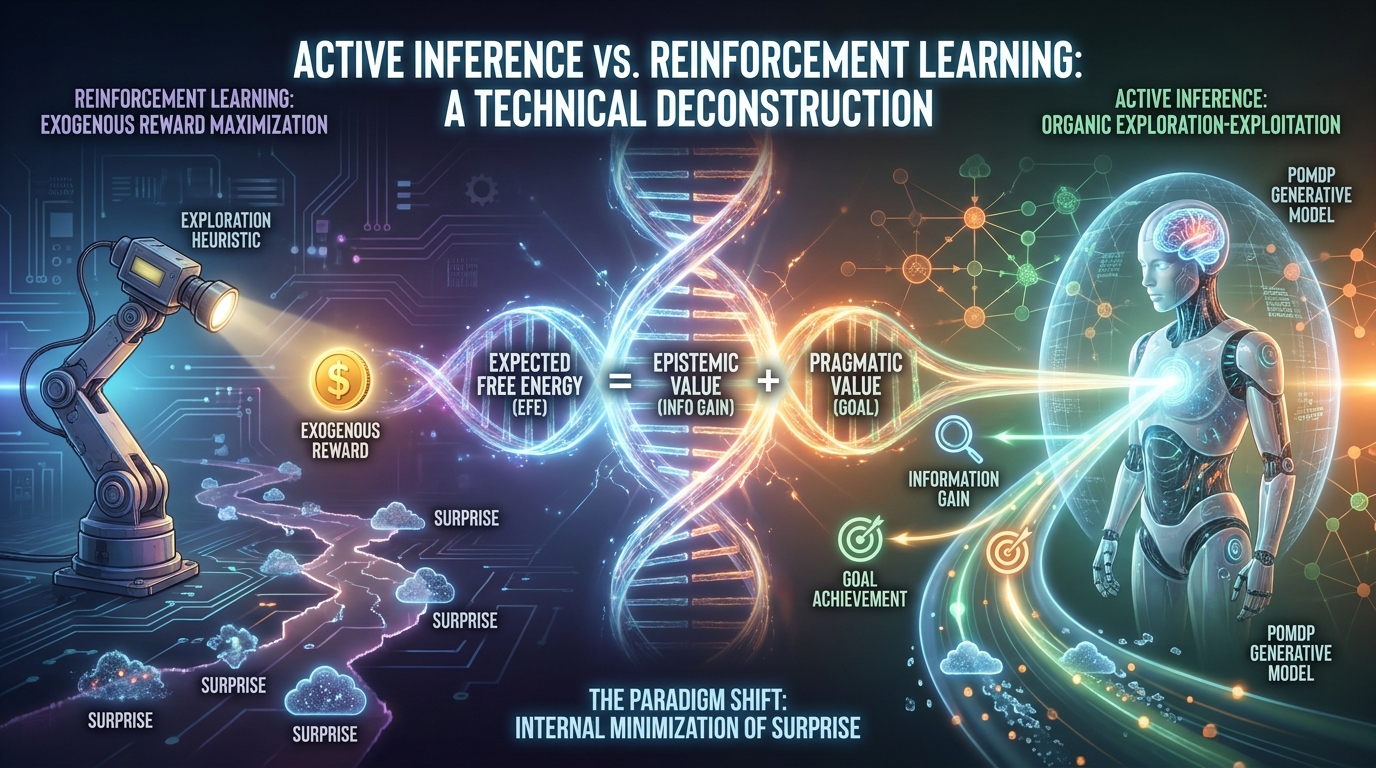
- Active Inference over Reinforcement Learning: Research suggests that active inference, rooted in the Free Energy Principle, offers a mathematically rigorous alternative to standard reinforcement learning (RL) by replacing exogenous reward maximization with the internal minimization of expected surprise (variational free energy).
- Dissolution of the Exploration-Exploitation Dilemma: Through the calculation of Expected Free Energy (EFE), the active inference framework organically decomposes decision-making into epistemic value (information gain) and pragmatic value (goal achievement). This unifies exploration and exploitation under a single objective function, permanently fixing the exploration weight at w = 1 and eliminating the need for manual hyperparameter tuning.
- The POMDP Generative Model: Active inference relies heavily on Partially Observable Markov Decision Processes (POMDPs) represented as factor graphs, allowing agents to infer hidden states from sensory observations while explicitly modeling future uncertainties and observation costs.
- Empirical Benchmarking & Performance: On complex benchmarks such as the 65,000-state Structural Inspection task, untuned Active Inference matches or outperforms reward-only planning, sitting precisely at the reward-maximizing knee of the Pareto frontier. In real-world BCI calibration, novel network-informed pipelines have demonstrated up to an 8% absolute performance improvement over traditional baselines (reaching 72% accuracy vs. 64%).
- Hardware and Architectural Recommendations (Scaling and Practical Horizons): While foundational active inference models have traditionally operated in discrete state spaces, emergent research indicates promising pathways for scaling these architectures using deep neural networks, with profound implications for autonomous robotics, conversational AI, and medical screening. For edge robotics, Active Inference allows real-time continuous adaptation on standard CPUs (achieving learning refresh rates of up to 80 kHz), avoiding the massive upfront GPU costs of Deep RL. However, for massive language models, the computational cost fundamentally shifts from training to inference, currently bottlenecking mainstream commercial adoption.
The quest for artificial general intelligence has long been dominated by the reinforcement learning (RL) paradigm, wherein an agent learns to optimize a policy by maximizing an exogenous, cumulative reward signal. However, as environments become increasingly stochastic, partially observable, and complex, the limitations of standard RL—particularly its reliance on heuristic, bolted-on exploration strategies—become glaringly apparent. Enter Active Inference, a theoretical framework originally birthed in computational neuroscience and cognitive biology, which is now emerging as a transformative architecture in artificial intelligence.
Active inference posits that biological and artificial agents do not simply seek rewards; rather, they act to maximize the evidence for their own internal generative models of the world. In simpler terms, agents act to minimize surprise. This epistemological pivot fundamentally rewrites the calculus of autonomous decision-making. By framing both perception (understanding the world) and action (changing the world) as continuous processes of variational inference, we arrive at a unified theory of behavior. While the mathematics underpinning active inference can be notoriously dense, the architectural implications are profound. This report provides a comprehensive, exhaustive deconstruction of the active inference framework, exploring its generative models, the mechanics of Expected Free Energy, and its comparative advantages over traditional deep reinforcement learning methodologies.
The Epistemological Foundations of Active Inference
To fully grasp the architectural shift proposed by active inference, one must first understand its origins in the Free Energy Principle (FEP). Originally formulated by Karl Friston, the FEP is a theoretical framework suggesting that any self-organizing system that resists a tendency to disorder must minimize its variational free energy. In cognitive science, this is often synonymous with the "Bayesian Brain" hypothesis, which posits that the brain is essentially a statistical inference engine continuously generating predictions about sensory inputs and updating its internal models based on prediction errors.
In the context of artificial intelligence, active inference translates this biological imperative into a computational architecture. Unlike passive machine learning models that merely map inputs to outputs, an active inference agent is continuously engaged in a dual process:
- Perceptual Inference: Updating its internal beliefs about the hidden states of the world to better match the sensory observations it receives.
- Active Inference: Executing actions in the environment to change the incoming sensory observations so that they better match the agent's prior predictions or preferences.
Both of these processes serve a single, unified mathematical objective: the minimization of surprise. Because direct computation of surprise (or Bayesian model evidence) is computationally intractable in complex environments, agents instead minimize a computable upper bound known as Variational Free Energy (VFE). (Analogy: Imagine walking into a dimly lit room and seeing a strange shadow. Your brain immediately generates a predictive hypothesis—a burglar! As you turn on the light to gather sensory observations, you realize it is merely a coat draped over a chair. By instantly updating your internal belief to perfectly match reality, you have minimized your prediction error, or Variational Free Energy.) By minimizing VFE, the agent implicitly minimizes surprise, ensuring its continued existence and operational stability within its environmental niche.
However, acting in the present is insufficient for long-term survival or goal achievement. An agent must plan for the future. This requires evaluating the consequences of hypothetical future actions. In active inference, this planning is governed not by VFE, but by Expected Free Energy (EFE). (Analogy: Imagine planning a route through a dark, unfamiliar forest. You can either take a known, circuitous path representing exploitation, or you can shine a flashlight down a new, shorter but unknown path representing exploration. EFE acts as a mathematical compass that inherently values the flashlight's information gain just as much as reaching the destination, smoothly shifting its priority toward pure goal-seeking as the map becomes clear.) EFE extends the variational principle into the future, scoring sequences of actions (policies) based on their anticipated ability to reduce uncertainty and fulfill the agent's goals.
The Architecture of the Generative Model: POMDPs in Active Inference
At the core of any active inference agent is a generative model. This model dictates how the agent believes the world works—how hidden states evolve over time and how they generate sensory observations. While active inference does not strictly mandate a specific structural format for its generative models, it is most commonly instantiated over Partially Observable Markov Decision Processes (POMDPs).
Deconstructing the Factor Graph
In the active inference literature, the POMDP is frequently represented as a factor graph. This graphical model provides a rigorous mathematical vocabulary for defining the conditional dependencies between random variables over time. As illustrated in foundational texts, these factor graphs utilize circles to represent random variables and squares to represent the factors or probabilistic matrices that relate them.
To understand the mechanics of this architecture, we must analyze the specific components of the POMDP formulation. The following table provides a comprehensive mapping of the core matrices that define the generative model in discrete-state active inference.
| Matrix / Variable | Notation | Role in Active Inference |
|---|---|---|
| Observation Matrix (Likelihood) | A | Maps hidden states to sensory observations. It represents the agent's belief about how the environment generates the data it perceives (e.g., if the state is "raining," the observation is "wet floor"). |
| Transition Matrix (Dynamics) | B | Describes how hidden states evolve over time, conditional on the agent's actions (policies). It captures the causal dynamics of the environment. |
| Preference Matrix (Prior) | C | Encodes the agent's prior preferences over future observations. This replaces the traditional "reward" function in standard RL. |
| Prior over Initial States | D | The agent's initial belief about the state of the world at the beginning of an episode or sequence. |
| Sensory Observations | o_t | The actual data the agent receives from the environment at time step t. |
| Hidden States | s_t | The unobservable, true states of the environment that the agent must infer from o_t. |
The synthesis of these components creates a complete, self-contained universe for the agent. At any given time step t, the agent receives an observation o_t. It uses the likelihood matrix A and its prior beliefs to infer the most probable hidden state s_t. If it is the beginning of an episode, the prior is determined by the D matrix; for all subsequent steps, the prior is computed by passing the previous state s_{t-1} through the transition matrix B, conditioned on the action selected by the current policy.
To make this abstract architecture concrete, the computational modeling of active inference agents has been democratized by open-source toolchains. For instance, PyMDP is a prominent Python package specifically designed for simulating active inference agents in discrete-state Markov decision process environments. By leveraging array-based programming, these libraries allow developers to explicitly define the A, B, C, and D matrices, generating a POMDP-style generative model out of the box. Below is a conceptual representation of how an active inference agent's generative model is initialized in code:
import numpy as npnum_states = 3 # e.g., Location A, Location B, Location C
num_obs = 3 # e.g., See A, See B, See C
num_actions = 3 # e.g., Move to A, Move to B, Move to C
A_matrix = np.eye(num_obs, num_states)
B_matrix = np.zeros((num_states, num_states, num_actions))
for action in range(num_actions):
 B_matrix[action, :, action] = 1.0
C_matrix = np.zeros(num_obs)
C_matrix[2] = 10.0 # Log probabilities/Nats
D_matrix = np.zeros(num_states)
D_matrix[0] = 1.0
This explicit parametrization is a double-edged sword. On one hand, it provides total mechanistic interpretability—every belief and transition probability is entirely transparent, contrasting sharply with the opaque weight matrices of deep reinforcement learning models. On the other hand, defining discrete matrices for highly complex, high-dimensional environments (like processing raw pixel data from a camera feed) suffers from the curse of dimensionality. This necessitates the integration of deep learning techniques, a frontier we will explore later in this report.
The Calculus of Expected Free Energy: Dissolving the Exploration-Exploitation Dilemma
The most profound theoretical contribution of active inference to artificial intelligence is arguably its natural dissolution of the exploration-exploitation dilemma. In classical reinforcement learning, agents must constantly balance exploiting known, high-reward actions with exploring unknown, potentially higher-reward actions. This balance is typically managed via ad-hoc, bolted-on heuristics such as epsilon-greedy algorithms (randomly taking actions a percentage of the time), temperature parameters in softmax policies, or explicitly engineered "intrinsic motivation" reward bonuses.
Active inference completely bypasses these heuristics. It achieves this by governing planning and action selection through a single, mathematically elegant objective: Expected Free Energy (EFE) [cite: 1]. While Variational Free Energy dictates perception (what the agent believes right now), EFE dictates planning (what the agent expects to happen under different hypothetical courses of action) [cite: 1].
The Dual Nature of Expected Free Energy
EFE is the quantity that an active inference agent seeks to minimize when evaluating a policy extending into the future. It is remarkable because the mathematical formulation naturally and rigorously decomposes into two distinct components that map perfectly onto the concepts of exploration and exploitation [cite: 1].
For a policy (a sequence of actions) $\pi$ and a future time step $\tau$, the expected free energy $G(\pi, \tau)$ evaluates the divergence between the predicted futures and the agent's prior preferences. Formally, it is expressed as the expected value under the agent's predictions about future observations and states, given the policy [cite: 1]:
G(π, τ) = E [ ln q(s_τ | π) - ln p(o_τ, s_τ | π) ]
Crucially, unlike VFE where the observations are fixed (given by the environment in the present), in EFE, the observations are predicted—they are imaginary random variables drawn from the agent's generative model of the future [cite: 1]. The agent imagines what it would observe and what states it would inhabit, and scores those futures. This overarching equation algebraically unpacks into two dominant terms [cite: 1, 2]:
- Epistemic Value (Information Gain): This term drives exploration, curiosity, and uncertainty reduction. It measures the expected reduction in uncertainty about the hidden states of the world upon receiving a future observation [cite: 1]. Mathematically, it is the conditional mutual information between future states and future observations, given the action. An agent maximizes epistemic value by seeking out observations that will teach it the most about its environment, inherently driving it toward novel or uncertain states.
- Pragmatic Value (Expected Utility): This term drives exploitation and goal-directed behavior. It reflects how closely the agent's predicted observations match its prior preferences (the C matrix) [cite: 1]. Formally, it equates to the negative cross-entropy between the predicted observations and the preferred observations. It reaches its maximum when the agent confidently expects to realize its most desired outcomes [cite: 1].
Because EFE naturally encompasses both terms in a single equation, exploration and exploitation emerge organically from minimizing a single objective [cite: 1]. There is no separate exploration strategy required. In the early stages of learning, when the agent's uncertainty about the environment is high, the Epistemic Value term dominates the EFE equation, driving the agent to explore and gather information. As the agent builds an accurate model of the world and uncertainty drops, the Epistemic Value approaches zero, and the Pragmatic Value term naturally takes over, driving the agent to exploit its knowledge to achieve its goals [cite: 1].
The Eradication of Hyperparameter Tuning in Exploration
The practical payoff of the EFE formulation is revolutionary. In standard Partially Observable Markov Decision Processes (POMDPs) that utilize reward bonuses for uncertainty reduction (often termed $\rho$-POMDPs), the choice of the intrinsic reward function and the weight placed upon it (the exploration parameter) must be tuned by hand for every specific task [cite: 3, 4]. If the weight is too high, the agent over-explores and fails to achieve its goals; if too low, the agent gets stuck in local optima.
Recent advanced research proves that minimizing EFE is exactly equivalent to solving a $\rho$-POMDP where the utility is expected information gain, but with a critical distinction: the exploration weight is permanently fixed at exactly w = 1 [cite: 2, 4]. Active inference removes the need for tuning entirely because the variational bound expresses both pragmatic and epistemic value in the exact same mathematical units—nats (the natural logarithmic unit of information or entropy) [cite: 2, 4].
This has been empirically validated across a spectrum of environments. In classic benchmark problems like the Tiger problem, RockSample, and massive Structural Inspection benchmarks containing over 65,000 states, the untuned, naturally weighted EFE objective matches or outperforms reward-only planning at equivalent horizons [cite: 1, 4, 5]. It specifically avoids the "over-exploration" trap caused by poorly tuned heuristic bonuses in traditional RL, sitting perfectly near the reward-maximizing knee of the success-reward Pareto frontier [cite: 1, 4, 5]. For engineers deploying AI in critical applications like fault detection or medical screening—where every exploratory test incurs a price and every missed fault carries a massive cost—EFE provides an out-of-the-box, belief-dependent utility that is mathematically derived rather than manually tuned [cite: 1, 4, 5].
Action Selection Mechanics
Once the Expected Free Energy $G(\pi)$ is calculated for all available policies, the agent must actually select an action. Rather than simply taking the argmax, active inference agents typically employ a softmax function over the negative EFE to generate a probability distribution over policies [cite: 1].
The probability of selecting a policy $\pi$ is given by:
P(π) = σ(-γ * G(π)) = exp(-γ * G(π)) / Σ exp(-γ * G(π'))
Here, $\gamma$ (gamma) is an inverse temperature parameter, often referred to as "precision" [cite: 1]. It represents the agent's confidence in its own policy evaluation. A high precision means the agent deterministically chooses the policy with the lowest free energy, while a low precision results in more stochastic, random behavior. Interestingly, in advanced active inference models, this precision parameter is not a fixed hyperparameter but is itself a hidden variable that the agent infers over time, allowing the agent to dynamically modulate its own confidence based on environmental volatility.
Paradigm Shift: Active Inference vs. Deep Reinforcement Learning
To fully appreciate the architectural disruption of active inference, it is necessary to contrast it directly with the reigning champion of autonomous AI: Deep Reinforcement Learning (Deep RL). The debate between these methodologies is not merely a matter of algorithmic preference; it represents a fundamental divergence in how we conceptualize artificial agency. The structural differences are detailed in the comparison matrix below.
| Metric | Deep Reinforcement Learning (Deep RL) | Active Inference (AIF) |
|---|---|---|
| Objective Function | Maximization of an exogenous, scalar reward signal (expected cumulative reward) via action-value functions. | Minimization of Expected Free Energy (EFE), subsuming reward as a prior belief/preference (minimization of surprise). |
| Exploration Mechanism | Bolted-on heuristics (e.g., epsilon-greedy, Gaussian noise, tuned intrinsic motivation bonuses). | Organically driven by the Epistemic Value term within EFE; mathematically fixed weight (w = 1), seeking information gain inherently. |
| Sample Efficiency | Generally low. Requires massive volumes of environment interactions to converge, particularly in sparse reward scenarios. | High. Directed exploration and generative modeling allow agents to squeeze maximum data out of sparse environments. |
| Compute Budget Allocation | Front-loaded. Massive compute spent during GPU-intensive offline training; highly efficient, cheap forward-pass at deployment (inference). | Runtime-heavy. Often skips massive offline training runs, but requires heavy compute at every control tick to execute policy search or gradient descent over free energy. |
| Uncertainty Handling | Often treats uncertainty implicitly or ignores it; relies heavily on stable, deterministic environment assumptions. | Explicitly models uncertainty (epistemic and aleatoric) within the generative POMDP factor graph as core variables to be minimized. |
Reward Maximization vs. Evidence Maximization
The central tenet of standard reinforcement learning is that agents seek to maximize the sum of cumulative rewards over time. The reward is an external, scalar signal provided by the environment (or a hard-coded objective function). The agent's internal machinery—whether Q-tables or deep neural networks evaluating policy gradients—is entirely dedicated to mapping states to actions that optimize this extrinsic signal.
Active inference, in stark contrast, proposes that agents act solely to maximize the evidence for a biased generative model [cite: 2]. The concept of "reward" is entirely subsumed into the agent's prior beliefs about the observations it expects to encounter (the preference matrix C). If a standard RL agent plays a video game to maximize its score, an active inference agent plays the game because it holds a strong, unyielding prior belief that it is the type of entity that observes high scores. Any deviation from a high score generates a prediction error (surprise), which the agent acts to minimize.
This perspective was famously cemented in a seminal 2009 paper by Karl Friston, Jean Daunizeau, and Stefan Kiebel, which boldly questioned the very necessity of reinforcement learning and control theory for optimizing behavior. By tackling a classic benchmark problem in dynamic programming—the Mountain Car problem—the researchers demonstrated that it was fairly simple to teach an agent complicated, adaptive behaviors using only a free-energy formulation of perception. The agent learned the causal structure of the environment and sampled it in a self-supervised fashion, naturally generating behavioral policies that mirrored those optimized by RL algorithms. Critically, this was achieved without ever invoking the notions of reward, value, or utility functions.
This proof-of-concept held massive implications for neuroscience—hinting at a reappraisal of dopamine's role in the brain away from a pure "reward signal" and toward a marker of "precision" or prediction error—but its impact on AI architecture was equally seismic. It proved that goal-directed behavior could emerge from pure inference.
Scaling to Complex Environments: The Deep Active Inference Frontier
Despite its theoretical elegance, active inference has historically faced significant headwinds in mainstream AI adoption due to scalability. The discrete POMDP formulations and exact Bayesian updates that characterize classical active inference are computationally crippling when applied to the high-dimensional, continuous state spaces where Deep RL thrives (e.g., controlling a humanoid robot or processing raw video feeds).
However, recent years have seen a concerted effort to bridge this gap, forging the subfield of Deep Active Inference. Researchers have begun exploring how ideas from active inference can augment traditional RL approaches, specifically by providing a more flexible conceptualization of reward and leveraging the inherent balance of exploration and exploitation [cite: 6, 7].
Pioneering work by researchers such as Alexander Tschantz, Beren Millidge, and others has focused on implementing novel objectives for decision-making inspired by the free energy of the expected future. By utilizing deep neural networks to approximate the generative models—often leveraging variational autoencoders (VAEs) (neural network architectures that learn probabilistic, compressed representations of complex data by mapping inputs to a latent statistical distribution rather than fixed points) or recurrent state-space models—these hybrid algorithms successfully balance exploration and exploitation in continuous spaces. They achieve robust performance on challenging RL benchmarks, particularly excelling in environments with sparse rewards, well-shaped rewards, and even scenarios with entirely no rewards (pure exploration) [cite: 7, 8].
These deep active inference architectures represent a convergence. They utilize the scalable function approximation of deep learning to handle complex sensory inputs, while replacing the traditional Bellman equation (the foundational dynamic programming equation in RL that decomposes the value of a decision into the immediate reward plus the discounted expected value of subsequent states) and reward maximization objectives with the Variational and Expected Free Energy bounds. This synthesis maintains the theoretical guarantees of epistemic exploration while allowing the models to run on modern GPU infrastructure. For example, in mobile network resource management on the AI-RAN testbed, a deep active inference agent (BRAIN) achieved a dramatically steeper reward curve, converging in far fewer episodes to a higher asymptotic reward than tuned heuristic baselines and leading Deep RL algorithms such as Soft Actor-Critic (SAC), Proximal Policy Optimization (PPO), DQN, and A2C [cite: 6]. In simulated robotic manipulation tasks, similar active inference models demonstrate substantial sample efficiency improvements over maximum entropy RL frameworks like SAC by systematically exploring sparse environments without relying on blind Gaussian noise [cite: 7, 9].
Emergent Frontiers and Domain Applications
As the mathematical and computational tooling for active inference matures, the framework is moving out of academic theory and into practical, domain-specific applications. The unique properties of EFE—particularly its un-tuned epistemic drive and explicit uncertainty modeling—make it exceptionally well-suited for fields where standard RL struggles.
Conversational AI and Linguistics
One of the most fascinating novel applications of active inference is in the realm of linguistics and dialogue systems. Standard Large Language Models (LLMs) operate via autoregressive next-token prediction, which is fundamentally a passive pattern-matching process. Active inference offers a paradigm shift: framing dialogue as a process of continuous free-energy minimization.
In this framework, speakers and listeners are modeled via a four-way Markov-blanket partition (a statistical boundary that separates a system's internal states from external environmental states, mediating all interactions strictly via sensory inputs and active outputs). Each entity selects or interprets utterances explicitly to minimize their variational free energy. The brilliance of this approach is how Expected Free Energy decomposes conversational moves. An utterance can be mathematically categorized based on its EFE components:
- Epistemic Utterances: Clarifying questions designed specifically to reduce the agent's uncertainty about the hidden state of the user's intent.
- Pragmatic Utterances: Statements, answers, or commands that fulfill the agent's generative goals (e.g., completing a task for the user).
This distinction is increasingly being utilized to select advanced prompting strategies for LLMs, allowing for more agentic, curious conversational models that know exactly when to ask for clarification and when to confidently provide an answer. While foundational claims regarding syntax-compliance and generative-dialogue remain largely theoretical—with critics pointing out that language prediction errors don't inherently prove the brain is executing literal Bayesian active inference—the architectural blueprint for uncertainty-aware conversational agents is highly compelling.
Brain-Computer Interfaces (BCI)
Active inference is also making significant inroads into neurotechnology, specifically Brain-Computer Interfaces. Because active inference was originally designed to model biological brains, utilizing it to interpret neurological data presents a natural synergy. In BCI applications, the BCI system itself acts as an active inference agent [cite: 10].
The BCI observes neural signals (the sensory observations o_t) and must infer the user's intended action or mental state (the hidden state s_t). By utilizing Expected Free Energy, the BCI can dynamically decide what information to present to the user on a screen (an action) to maximize epistemic value—effectively probing the user's brain with specific stimuli to reduce its own uncertainty about what the user is trying to communicate. This bidirectional, symbiotic inference loop promises faster, more accurate BCI calibration and operation compared to static machine learning decoders. For instance, recent studies testing model-based approaches and network-informed pipelines rooted in cognitive learning have demonstrated significant reductions in calibration dependency, with modern BCI pipelines like Ana-E exhibiting up to an 8% absolute performance improvement in between-participants analysis (achieving 72% accuracy over the second-best pipeline's 64%) [cite: 11].
Robotics, Fault Detection, and Mobile Sensing
In physical domains like autonomous robotics, mobile sensing, and non-destructive structural inspection, the cost of taking an action is high. Standard RL models struggle here because they require immense amounts of trial-and-error to learn the value of information. Active inference models thrive because the EFE formulation inherently calculates the expected information gain (epistemic value) alongside the physical observation cost (pragmatic value) [cite: 4].
To ground this in reality, consider the ThoughtForge Active Inference Framework (AIF) deployed in industrial automation. Instead of relying on predefined rule-based motion programming or massive cloud-trained datasets, ThoughtForge utilizes Universal Robot six-axis robotic arms equipped with Framos cameras and force-torque sensors [cite: 12]. Running solely on a standard CPU at the edge, this active inference AI continuously adapts to random vertical and rotational physical disturbances in real-time. It achieves learning refresh rates of up to 80 kHz without the latency or security risks of cloud-based GPUs [cite: 12, 13]. Other real-world case studies include TU Delft's Mars rover prototypes, which autonomously balance rock-finding (goal-seeking) with terrain mapping (uncertainty reduction) without hand-tuned exploration bonuses, and UCL's adaptive prosthetics, where bionic hands minimize prediction errors about user intent to adapt grips in real-time more naturally than standard EMG-based systems [cite: 13].
The Industry Friction: Why Mainstream AI Labs Have Not Migrated to Active Inference
After reviewing the mathematically rigorous advantages of Active Inference—specifically its eradication of exploration tuning and extreme sample efficiency—a glaring operational question arises: If this architecture is demonstrably superior to reinforcement learning, why are tech behemoths like OpenAI, Anthropic, and Google still relying almost entirely on standard Deep RL, specifically Reinforcement Learning from Human Feedback (RLHF), for their frontier models?
The answer lies in the harsh realities of computational physics, legacy infrastructure, and the specific dynamics of scaling. The friction preventing a mass industry migration involves three core limitations:
- The Compute Budget Inversion: In standard Deep RL (like PPO and SAC), the compute burden is heavily front-loaded. You spend millions of dollars on massive GPU clusters to train a policy network offline. Once trained, deploying the model (inference) is simply a fast, incredibly cheap mathematical forward pass [cite: 13]. Active Inference flips this paradigm. While it can skip the massive offline training runs, the agent must perform computationally expensive policy search, or run continuous gradient descent over free energy, at runtime to update its beliefs during every single control tick [cite: 13]. For a 70-billion-parameter language model serving millions of concurrent API requests, injecting this heavy dynamic inference loop at runtime is currently unscalable and cost-prohibitive on existing A100/H100 hardware architectures [cite: 13].
- RLHF is a "Good Enough" Proxy for Preference: Current labs use RLHF because preference-based alignment frames abstract human desires into a relative ranking task (which humans are good at), and PPO is a workable (if unstable) engine to update policies [cite: 14, 15]. While RLHF suffers from severe limitations—such as "reward hacking," sycophancy, and objective mismatch because the Reward Model (RM) is an imperfect proxy for human preference—the tech industry has invested billions into stabilizing these exact flaws via heavily engineered KL-divergence penalties and massive data pipelines [cite: 16, 17].
- Software and Framework Entrenchment: The current deep learning ecosystem is structurally optimized for backpropagation and maximizing exogenous rewards. Transitioning an enterprise ML stack to Active Inference requires completely rebuilding the generative model layer, replacing PyTorch-optimized PPO loops with belief-updating POMDPs, and rethinking how uncertainty is explicitly modeled in continuous spaces. For labs racing to push the next parameter-scaling milestone, this architectural reset represents an unacceptable delay.
Consequently, while OpenAI acknowledges that new, fundamental paradigms will be required to align and control models that exceed human intelligence—because RL agents will inevitably exploit the flaws in learned reward proxies—the sheer commercial inertia keeps Deep RL on the throne for now [cite: 17].
Synthesis and the Path Forward
The landscape of artificial intelligence architecture is currently dominated by monolithic models scaling up raw compute and data. Yet, the epistemological ceiling of this brute-force approach is rapidly approaching. The necessity for sample-efficient, highly adaptive, and inherently curious agents is driving the search for alternative architectural paradigms.
Active inference, underpinned by the Free Energy Principle, presents one of the most mathematically rigorous, philosophically cohesive alternatives to traditional Reinforcement Learning. By re-framing the problem of autonomous action from one of external reward maximization to internal surprise minimization, it elegantly bypasses decades-old hurdles. The Expected Free Energy functional, by naturally decomposing into epistemic curiosity and pragmatic goal-seeking in the exact same mathematical currency, represents a masterclass in objective function design.
While challenges remain—particularly in the continuous scaling of the generative POMDP models and navigating the computational constraints of running real-time belief updates—the integration of deep learning techniques into active inference architectures signals a highly potent future. As autonomous systems are deployed into increasingly high-stakes, uncertain, and un-mapped environments, the ability to act not just for reward, but for the inherent, mathematically optimized reduction of uncertainty, will transition from a theoretical luxury to a structural necessity.